Showing posts with label X-Men. Show all posts

Tuesday, January 7, 2014

Why I do believe movie studios listen to comic book fans

Every time people get on the subject of a superhero film, or any other movie based on a comic book, it seems like someone will always claim that "comic book nerds" don't matter to the film studios.

Now, that may seem like common sense.  After-all, a single comic book is lucky to sell 100,000 and who cares what some fat, sweaty guy who plays Dungeons & Dragons thinks, right?  But are the tastes of people who read comics and weigh in on them on the internet that different from those of everyone else?

Besides, for something so "nerdy," it seems like there's an awful lot of people who play poser to it.  After-all, don't graphic novels that have been on bookshelves long enough eventually turn a pretty decent run?

In 1989, Warner Bros. released Batman which was a dream come true for Batman fans who had been reading him starting in the 1970s, when his adventures took on a more gloomy tone, and the deeds of his enemies became more heinous.  Oh, it took many liberties with the stories, but at the time, many fans felt it was just great to see a movie like this, which became the biggest movie of the year in the United States.


1992 saw the inevitable sequel, but some fans weren't happy.  They could no longer overlook Batman's willingness to kill, and the monstrous look of the Penguin, so different from the comics.  There were script problems from day one as well.  And yet, many other fans thought it was terrific, however, many parents had taken their kids to see it not realizing that there were elements of the film that children would find scary and depressing.  It was only the third-biggest movie of the year in America.


To remedy this, Warner Bros. released Batman Forever, which replaced the gloomy German-expression inspired look of the first two with a more exciting music-video like action flick.  The villains were as comedic as in the 1960s Batman TV show--which, mind you, was a comedy in the vain of Get Smart and fans were divided over the inclusion of Robin.  Consensus among fans was that the movie was a major disappointment.


Warner Bros. laughed all the way to the bank, however, as it became even more successful than Batman Returns (it was the second biggest film of the year) and continued on with Batman & Robin which was one of the most universally-decried films of the last twenty years.  While it opened fairly strong, the film was ultimately considered a disappointment, if not a flop.  While a low-budget Spawn movie did respectable, if unremarkable, business at the box office, and the Men in Black movie was an enormous hit, but it seemed that Batman's days of box office supremacy were over as the film came in 12th in the domestic box office.


Had Warner Bros. learned their lesson?  Before we had a chance to find out, three years went by before 20th Century Fox released X-Men.  Now, this is a strange case because the idea of the team as being feared and hated by ordinary humans was kept, as for a lot of the drama of the comics.  It also featured Patrick Stewart as Professor X, who had been Wizard Magazine's choice for the role since their first fantasy cast in 1994.  Inevitably, there were characters who were altered quite a bit to support the story, and the costumes were pretty much unrecognizable.


The film did well, but was nowhere near what the first three Batman films had been.  A year later, Warner Bros had put Superman back on the small screen in the form of Smallville, which covered his high school years, wherein he slowly learned to use his powers and deal with the typical problems of a teenager in Kansas.  The show was a success, but with his costume nowhere to be seen, it was almost more like an urban fantasy (or, well, rural fantasy) version of the character as X-Men had been more of a straightforward sci-fi/adventure film in the vain of Star Trek.

The cast of Smallville when the series began.
© 2001 Warner Bros.
Fans' opinions on each of these projects was divided.

That may have held true of Columbia's 2002 blockbuster Spider-Man, but with its box office earnings, it just didn't seem to matter.  While there were still small changes to the mythos (the most talked about of which was Spider-Man's webs coming from his actual wrists instead of gizmos placed on them), his costume was much as it had been in the comics, with the main difference being in texture, and the idea of a teenager with coming-of-age problems and who fought crime because he had failed to prevent the killing of his uncle when he had the chance remained.


There were fans who nitpicked the changes as minor as they were.  There were also those who felt it wasn't the best film it could be in general.  But for the most part, it was considered a blessing from fans.

In the meantime, Smallville kept going strong, while a sort-of Batman spin-off Birds of Prey only lasted one season with many viewers complaining that it was confusing.  Welcome to our world.

I'm Facebook friends with Dina Meyer, and I thought Ashley
Scott was incredibly nice when I met her at SDCC.
© 2002 Warner Bros.
The show made a brief allusion to Smallville (suggesting that in this universe, Superman was far younger than Batman and even Batgirl) but never crossed-over.  Birds of Prey had many similarities to Smallville--a modern rock soundtrack, an attractive cast, no costumes for the heroes except in flashbacks) but predictably had a much different atmosphere and premise.

While the series was cancelled after just one season, the show runners were given the opportunity to reshoot the final episode, which showed that they at-least cared what viewers thought as far as it went.

During the next two years, X2 (why they couldn't call this otherwise fine film X-Men 2 is beyond me) and Spider-Man 2 did great business at the box office, each about as faithful as their predecessor.  On the other hand, Daredevil was a mediocre hit, and The Punisher more-or-less broke even, while The Incredible Hulk was basically a high-profile flop.  All of these films were fairly faithful.  It may not have helped that the independent comic-based League of Extraordinary Gentlemen--a tepid film that really would have been lame even for the '90s--was also something of a flop in the domestic box office.


However, none of these films did quite as bad as Catwoman, starring Halle Berry in the title role.  I cannot comment on this film in that I haven't seen it, but in addition to terrible reviews, there didn't appear to be any fidelity to the source material.  They changed her secret identity, and I'm under the impression she had cat-powers.  I'm also under the impression, she's a straight-up hero (if maybe an anti-hero) as opposed to the burglar with a heart of gold as seen in the comics and cartoons.

Oh shit, almost forgot, here's the Spider-Man 2 trailer.


Despite what Catwoman implied, however, Warner Bros. had been listening to Bat-fans.  The next year Batman Begins was released.  Fans had been clamoring for a "Year One" type film since almost immediately after the release of Batman & Robin.  The film not only returned Batman to the darkness of the past (where he'd been in the comics all along), but also stayed somewhat closer to the source material.  The film made Joe Chill the killer of Bruce's parents as he had been in the comics, and used the idea that it was a mob-hit made to look like a robbery--a product, ironically enough, of the '50s comics.  We also saw Bruce training with Rah's al Guhl, a major character in the comics and in the animated series, but who had never appeared in live-action.  The film even ended with a tease for the Joker, that was straight out of Batman: Year One.


That's not to say the film never tarried from the source material.  They still had a black, armored costume and the love-interest was an original character; but compared to Batman & Robin, not only was this film practically a work of utter genius, it was also practically verbatim what was in the comics.

And yet, while the film faired mostly well with critics, some felt it was tedious and that too much attention was devoted to things like the creation of Batman's gadgets.  In box office figures, the film did well, but didn't quite restore Batman to his early '90s glory days.  What I will say is that the film had a certain feel to it like it was faithful to the comics without trying to rest on the laurels of being based on them.  This sort-of takes the X-Men formula to a higher level.  It's its own movie, and I really think that it was the greatest superhero film of all up to that point, though Spider-Man 2 and Superman: the Movie are strong contenders as well.

The same year, a Fantastic Four movie hit the screen.  It was reasonably faithful, with the predictable watering-down of the main villain.  It just… sucked.  But it wasn't exactly a flop.


By this point, it's obvious that filmmakers and studios saw the value in fidelity to the source material as well as seeking the opinions of the base.  But does that mean they started giving a rat's ass about what fans think?

Well, I think we've gone long enough without defining the word "fan."  A fan doesn't necessarily mean someone who's at the comic book store every Wednesday

X-Men: The Last Stand or whatever the third film stepped away from treating the series as straight sci-fi/adventure and went with something with more of a superhero feel, even if the costumes were, for the most part, what they had been in the earlier films.  It still took liberties with the characters--Cyclops' death being a case-in-point--but it was also just incredibly cheesy.  That was the conciseness among fans, though the film did well at the box office.


But that summer came the most divisive film in superhero history.

Superman Returns is a movie I cannot describe in objective terms, because it just pissed me off that royally.  I'll try: it was a broad-strokes sequel to the Christopher Reeve film (according to its press, it followed the first two but ignored the later two) and the idea was that Superman left for five years because some scientist discovered evidence that Krypton might not have blown up.  Right off the bat, this premise is contrived at best, and self-serving on his part at worst.  But anyway, he returns to find that Lois had a son and has a boyfriend.  Lo and behold, he discovers that he's the child's true father.  Oh, and there's some bullshit about how Lex tried to use the crystals from the Fortress of Solitude to… um… turn North America into that so people would pay to live there?


This offensive, nonsensical gibberish brought in $200 million at the U.S. box office with an additional $191 million overseas.  It garnered a 77% on Rotten Tomatoes as well.  These numbers aren't that bad, but when you look at the $270 million budget (whether or not that includes prior attempts to create a Superman film) and the aim of critical prestige, it really wasn't that big a deal.  Yet, many fans love it.

Why?

Well, because: it said it was faithful.  How did it manage that?  Well, the film went into pre-production soon after the deaths of Marlon Brando and Christopher Reeve, the stars of 1978's Superman: the Movie which began the age of blockbuster superhero films.  It was produced by Alexander and Ilya Salkind, the later of whom was a big fan.  Warner Bros. distributed and largely financed it, but it was basically a Salkind production, so the corporate era really began with Batman.

That's why it's easy to say that blaring the John Williams music enough, finding a guy that resembles Christopher Reeve enough, and quoting enough lines from that classic of classics was "faithful" even if the plot was out-of-character shit.  At the time, Superman: the Movie was considered more-or-less the granddaddy of superhero films, despite some infidelities and important reboots and events in the comics since it came out.  Yet, there was a divide between "comic book fans" and "Donner fans," in the years leading up to Man of Steel.  And I hold Superman Returns director Bryan Singer--who had masterfully helmed the first two X-Men films--as the prime suspect.

Now, take another look at the box office figures and critical response.  Does this sound worthy of a sequel?  I mean, it's more-or-less what Batman Begins took in, albeit on a much larger budget.  Bear in mind also that Batman's comics have also sold more in general, with some major exceptions, and that Batman's prior films were more recent and more profitable than Superman's, even adjusting for inflation (Superman IV was an unmitigated disaster at the box office, and III was a modest hit) and Bats had done better in TV animation and far better in video games--in fact, Superman's rep in the world of video games was considered terrible.

However, Superman did still have a feather in his cap, which was that he had always been successful in live-action TV.  The Adventures of Superman was a nugget of the golden age of television proving there was life before Reeve, Superboy was a cult favorite, Lois & Clark was a respectable prime-time hit for ABC, and Smallville was still going strong when Superman Returns came out.  Plus, the first two Christopher Reeve films had been huge hits, as long ago as they were released, and the 1992 Death of Superman arc, and its sequel Reign of the Supermen (I'm trying to explain it in terms a studio board member would understand) were big-sellers, with the death issue itself selling about three million copies.

Meanwhile, many fans felt Superman Returns was a great accomplishment and embodied everything they'd wanted in a Superman film--especially after years of rumors and leaks of a very unfaithful film in the late '90s and a slight improvement in the early '00s--but many others, including myself, flatly didn't. Some like me were offended by the scenario.  There would be no way to follow it up without making Superman a deadbeat dad at-least at the beginning of the movie.  Others felt the original films were too old anyway, and hadn't aged as well as some of their contemporaries.  I could see where that was coming from, but I feel that if the Star Wars films could have prequels, Superman could have sequels if they loosely adapted more recent stories.

I'm not sure, but I think D.C. was trying to test the waters when they released Superman: Doomsday, the first in a line of animated films based directly on stories from the comics, and with no ties to any other animated or live-action projects.  I really hated Superman: Doomsday, but the next one--Justice League: New Frontier--was a gem, and one day, I'll review them in greater detail; but today, I'm here to talk about theatrical releases.

2007 was not a great year for superhero films.  While in the U.S. box office, Spider-Man 3 reigned supreme, Ghost Rider and Fantastic Four: Rise of the Silver Surfer barely covered costs.  Movies based on non-superhero comics were also coming into the fray.  A CG-animated Teenage Mutant Ninja Turtles film aimed low with a $34 million budget, but hit its mark with $54 million domestic.  300 was a surprise hit and marked Zack Snyder's entry into the arena of comic book adaptations.  But it was Michael Bay's Transfomers, which we can call a comic book adaptation because the first fiction for the characters was the Marvel comics, was a tremendous hit.


Back to Spider-Man 3, though: it adapted the symbiote costume saga and the advent of Venom with a reasonable amount of fidelity… but the role of Eddie Brock was miswritten and miscast.  Bryce Dallas Howard was good as Gwen Stacy, but the role of the character was unlike in the comics and they seemed to be using her for every moment they needed a female of childbearing age who wasn't Mary Jane.  The Sandman story was good, and he made for the perfect foe for Spider-Man in the living costume; but while the story of him being Uncle Ben's true killer was almost like a retroactive Batman-esque "have the villain kill the parents" moment.  But more importantly, the symbiote isn't well set up or explained, the scene where "dark spidey" goes nuts in a coffee shop is beyond lame, and the special effects were just a little behind the times.

In other words, fans generally acknowledged that it was faithful enough, but it still sucked.

The following year, however, superhero films turned a page.


When that trailer hit… we knew a new era had begun.

© 2008 Marvel Entertainment
The first production of Marvel Studios, Iron Man was, to many people, the ultimate "comic book movie."  Not only did the costume look a lot like in the comic books of the time, but the film was faithful almost to a fault.  When Tony first escaped from the camp, he wore the original clunky armor that many fans never thought they'd see on the big screen.  Practically every supporting character from the comics appeared in one form or another.  And most importantly, it ended with a post-credits scene in which Nicky Fury, played by Samuel L. Jackson, telling Tony that they're "forming a team."

Later that year, Tony Stark appeared again The Incredible Hulk, a film that was marketed as a reboot to the 2003 disappointment that was Hulk, and yet, seems to almost take up where the last film left off (Banner is in Brazil) and don't devote much time to the origin, however they do provide a new origin in a brief flashback and explain that it was part of an experiment to replicate the super soldier serum from World War II.  Also, there was a new cast, which sold the idea that it was a reboot, but to moviegoers unimpressed by the first film or unfamiliar with the Marvel Studios plan, it wasn't a big deal.  This film didn't really do much better than its predecessor, and the big problem remained that the CG Hulk wasn't convincing enough.  By that point, however, Iron Man--a superhero who was largely unknown outside of comics and video games--had made his mark, even if the hero who had been Marvel's biggest hero in the late '70s/early '80s (unless you count the Star Wars characters) was clearly not the draw he used to be.


By the middle of July, though, the disappointment of the Hulk movie didn't matter.  Batman Begins had built up a following on DVD, and critics were raving about the performance of Heath Ledger, who had died since the film wrapped up shooting.  Fans' early reactions to stills from the film was a bit tepid in some cases, as the Joker bore scant resemblance to the comics and there was division over the decision to simply title it The Dark Knight; but by the time the film was on the way to theaters, nobody could hide their curiosity.

The Dark Knight quickly became one of the biggest films of all time, with critical response through the roof and Oscar buzz (and an eventual win) for Ledger.  It was the biggest movie of the year, and until Avatar won out, the entire decade.


While the plot of The Dark Knight is not without its influence from the comics, nor is it something that couldn't happen in the books (except, arguably, the ending) it wasn't a direct adaptation.  Fans can debate whether the Joker was ultimately more similar to the comics or less than the Jack Nicholson version, and the inclusion of the Wayne Foundations (which owed itself to the comics of the early '70s) was probably neat for some fans but lost on others.  One of the main differences between Superman & Batman vs. most of the Marvel stable, is that these two heroes have been in several influential films and TV shows, and rebooted several times in the comics; while the Marvel bunch has seldom been in live-action films of note (the '70s Hulk TV show is a major exception) and the comics were rarely rebooted, notwithstanding Ultimate Marvel.  Even the animated series' tend to be more-or-less direct adaptations of certain stories, while D.C. animation has tended to add its own creations into the mix (compare Justice League Unlimited and Avengers: Earth's Mightiest Heroes).

2008 marked a new era because it was obvious that a couple of very different superhero films could come out and be the top two films of the year.  It also founded the idea that Marvel's films (20th Century Fox's  had a more playful, colorful style while Warner Bros.' films based on D.C. heroes tended to try for more of a "realistic" style.  Which is "better" has been the subject of bitter debate among fans, and it's these two films that have set the discussion.

There was also a Punisher reboot that year… but I never saw it and don't care.

The following year, 20th Century Fox released X-Men Origins: Wolverine, which leaked early, and garnered negative press there from.  Despite being Fox's most faithful X-Men film to date, it was not well-regarded, but Fox soldiered in the years to come and the box office returns were fair.


Less commercially successful was Watchmen, an adaptation of the most acclaimed miniseries-cum-graphic novel of all time.  The film took some liberties, mostly with the ending and the costumes.  In my humble opinion, some of the redesigned costumes were improvements and if anything, some of the revisionist history was probably confusing to less-informed moviegoers (e.g. Nixon still being president in 1985).  In my humble opinion, the film was very faithful, but it seemed like a lot of fans were upset about what changes were made, and incredibly, some fans even criticized the more incidental moments (the old man and kid at the comic book shop) which is to say that this is simply one of those films where the stereotype of overzealous fans nitpicking minor changes was demonstrable.


Was this a case of a movie studio and filmmaker not listening to fans or fans expecting something not in the cards?  Bear in mind that until after the film came out, Watchmen was a completely self-contained story that took place outside of the D.C. Universe and had no prequel, sequel or spin-off of any kind.

This was enough to make me want to see
the G.I. Joe movie.
© 2008 Paramount
That same year, films like G.I. Joe: Rise of Cobra, Star Trek and Transformers: Revenge of the Fallen were based on franchises targeted to the same audience as superhero films.  Again, the Transformers and the G.I. Joe characters' first fiction originated in comics, while Star Trek was very influential in comic book/superhero circles, with actors from the various Trek series' appearing regularly at conventions.  For what its worth, many fans felt Transformers had been an embarrassment and did not like what they were seeing with its sequel or the G.I. Joe movie.  Even Star Trek was quite controversial because of some feeling that they shouldn't reboot the beloved space saga.

There was also a film called Avatar that became the biggest film ever.  But it wasn't based on anything, so we don't need to talk about it.

Meanwhile, a sequel to Superman Returns had been scheduled for 2009, but nothing seemed to be happening.  Superman Returns action figures with a Man of Steel logo appeared on the shelves of Target, and the presumptive name of the sequel was indeed Man of Steel, but not one frame of footage appeared to have been filmed.  Had the movie been cancelled?

Many fans sure wanted it to be cancelled, but again, many didn't.  However it was increasingly obvious that those who did want a reboot tended to be either non-fans, or fans of comics beginning in 1986, following Crisis on Infinite Earths and the reboot miniseries Man of Steel; while those who favored the earlier "pre-Crisis" comics or the Christopher Reeve films wanted a sequel.  If Warner Bros. was indeed listening, it had a choice to make, and it looks like they did as early as April 22.

Perhaps this quote from Jeff Robinov in a 2008 interview with the Wall Street Journal sheds some light on this subject: "we're going to try to go dark to the extent that the characters will allow it."  In that interview, he said they had been disappointed in Superman Returns and that they'd planned to "reintroduce" the character, although it wasn't set in stone.  Still: to that point, there had been little, if anything, to suggest that a reboot was in the offering.

Moving on to 2010, Iron Man 2 hit theaters.  By this time, fans were used to sequels that improved upon the first outing: X2, Spider-Man 2, The Dark Knight, and in some people's opinion, Superman II and Batman Returns.  This time, however, there was a disconnect.  Had Iron Man 2 been a faithful film that managed to excite and tell a great story?  Or did it get bogged down with in-jokes and meandering plot threads?  Most importantly, was it getting people excited about the upcoming Avengers film, or did the setup get in the way of a good story?


At this point, the later seems to be the more common opinion, though at the time, the excitement was still bubbling for the big crossover.

Iron Man 2 was the only big superhero film of 2010, though Warners put out a film about the western D.C. Comics character Jonah Hex, which faired very poorly.  Iron Man 2 was the third biggest film of the year showing that he was still going strong.  In my humble opinion, the film may have some rather huge flaws, but it was certainly the type of film many fans had been hoping for.  They just should have put more effort into creating an honestly-good film instead of a celebrity pajama party.

By this point, a reboot had been announced, not of Superman, but of Spider-Man, whose massive success at the box office and fidelity to source material had been an inspiration to Hollywood for nearly a decade.  It seemed odd, since Spider-Man 3 had done well financially, and even the internal politics (director Sam Raimi's falling out with Columbia/Sony and star Tobey Maguire's leaving apparently out of loyalty) didn't seem like the series needed a reboot.  But the decision had been made.

The next year saw the release of four mainstream superhero films, all trying to be at-least somewhat faithful.  Thor was the first one out of the gate.  While the film was mostly popular and got good enough ratings, influential critic Roger Ebert gave the film a scathing critique.  Ebert's no snob by the way.  For my money, the film was okay, but nothing special.  My knowledge of early Thor comics is limited and my knowledge of later Thor comics is nonexistent, so all I will say is that originally he had a secret identity in Don Blake, a handicapped doctor whose cane turned into the hammer of Thor and he turned into the deity; yet, this is not covered in the film, although there's a brief mention of someone named Don Blake.


X-Men: First Class served as proof that Fox was trying to get a little more faithful to source material, but they were still off and had no choice but to be off because of how their "universe" was structured.  The film had elements of a '60s spy thriller and even managed to incorporate a real-life event (the Cuban Missile Crisis) into the narrative.  It had its flaws, but I actually recommend it as something that tried to be as faithful as it could be, mostly using unfamiliar characters, with new actors as the younger Charles Xavier and Magneto, both of whom will return in Days of Future Past along with their older counterparts.


But the biggest disappointment of the year was Warner's D.C. adaptation Green Lantern which I'm honestly afraid to talk about.  I said something about it being a mediocre film and someone excoriated me as this fanboy who just wants everything to be 100% like the comics.  Then, about a year later, I said it was fairly generic, but that I didn't think it was any worse than Iron Man 2 or Thor and said I was just a D.C. fanboy who had no objectivity.

Anyway, I didn't see much in the way of infidelity given my narrow familiarity with Green Lantern.  From what most people said, he was too cocky and irresponsible, which was inconsistent with Hal Jordan's personality.  My problem is that it was just generic and didn't have much going for it, with a character who should have been interesting visually.  There's also too much emphasis on the love story and not enough on what could have been a fascinating look at this intergalactic authority.  For a better film, check out the animated Green Lantern: First Flight.


Now, at some point, D.C. seemed to hope that Green Lantern would become their hero that just suddenly gained a new popularity like Iron Man, and be their third--or even second--most popular superhero.  Yet, it just was not to be.  The movie does serve as food for thought, however: if this had the Marvel logo on at the beginning and tied in with another superhero, would it have done better?

Thankfully, the final superhero movie of that summer was awesome and faithful to the comics.  Captain America: the First Avenger followed the title hero from his origin as a young private who volunteers for an army experiment to grow bigger, stronger, faster, etc. to his seeming demise in the frigid sea with the film ending in modern times as we get a preview of the Avengers film after the credits.


There are scenes taken virtually verbatim from Ultimate Origins and yet, the film feels fresh, almost like Marvel's stab at an Indiana Jones type of adventure.  The cast is incredible and while the story isn't gobsmackingly original, it is a thrilling adventure and ode to the most important period in superhero history.

The following year was something of the year of the superheroes.  The Avengers was the biggest movie of the year.  No, it's not 100% faithful to the comic book.  In order for that to be the case, Cap would have to appear either toward the end, or not at all.  Plus, you'd have to swap out Hawkeye and Black Widow for Ant/Giant Man and Wasp.  But for all the razzle-dazzle, references to comics, the fact that it had basically the same villain as in The Avengers #1 49 years earlier, and that a plethora of other films lead up to it, it's pretty damn faithful if you ask me.


Not only that, but it was produced by a comic book company that had become a movie company.  That's the key: Marvel had been producing the Iron Man films, and all other films that lead up to this one.  There's not much to talk about as far as the plot goes, but whatever.

Later that summer, the Spider-Man reboot came into fruition.  This time, the backstory of Peter's mother and father had more to do with it and Gwen Stacey (the love-interest in late '60s/early '70s comics) was written much as she had been in the comics, rather than the catch-all female of Spider-Man 3.  Spider-Man's web-shooters returned, rather than having given Peter the power to spin webs on his own--one of the few controversial liberties taken with the Raimi films--and the costume was changed to something still recognizable, but in my opinion, cheesier.  I'm glad to see they've essentially returned to the classic costume in the upcoming film.


While I think The Amazing Spider-Man was ultimately a better film than its predecessor, it isn't such a vast improvement that it warranted making a reboot just ten years after the original.  It is only slightly more serious and slightly darker.  Both versions depend on Peter and Ben having a heated argument before Ben is killed to ratchet up the guilt, and while the idea that Peter goes on a manhunt to find the killer which is never resolved is an interesting twist, it just never seemed like this reboot was born out of anything but inside baseball.

Incidentally, Sony's other top franchise (I hate that word) returned that year, surprisingly out-earning Spidey with Skyfall, the third film to feature Daniel Craig as James Bond.  Many people were confused about the timeline with respect to his initial outing, Casino Royale (it took place when Bond was in training, but it was still the Judi Dench version of M, whose hiring was a major hurdle for Bond in Goldeneye because he had to… *gasp*… take orders from a woman), but Skyfall actually seemed to be having fun with the idea that there's no solid timeline for Bond.

I don't think we can look forward to that kind of artsy-fartsy approach with Spider-Man, but time will tell.  In the meantime, it did well at the box office, but was only the seventh biggest film (the first Spidey to not be #1 or 2) in the yearly box office and came in well under $300 million, unlike the others.

Then, of course, came The Dark Knight Rises: the third in what's known as the Dark Knight Trilogy.  Where the first movie was quite faithful and the second one was something that could happen in a Batman comic, this one throws it out the window, catching up with Bruce long after he's hung up the cape after the events of the previous film.  He returns (with a flying Batmobile) to do battle with Bane.  Yes, the part where Bane snaps his back is derived from Knightfall, but the rest of the film is devoid of resemblance to the comics.  I won't spoil it, but let's just say there's a reason they've introduced a new Batman to join Superman in his upcoming film, despite the first teaser for the flick being shown along with The Dark Knight Rises.


It may sound like I'm saying that TDKR was written without fans in mind, but by this point, a veritable religion had grown around these films, and Warners had put the man behind them in charge of kickstarting their oldest and debatably next-most-popular superhero.

There were nods to the comics, and ultimately, it played like a high-concept Elseworlds graphic novel.  I think what we've learned here is that with the two oldest and greatest superheroes, they've been storied, adapted, rebooted and merchandised so much over the years that there's no way any movie could please the bulk of the fan base and not be controversial.

That will take us to 2013's Man of Steel, but first the biggest movie of that year was, once again, an Iron Man film.  It seemed inevitable that Iron Man 3 would be the biggest superhero film of the year and that it would face more competition from the sequels to The Hunger Games and The Hobbit than Superman might have to offer, especially coming off of The Avengers.  There were continuity nods, but it was actually a little more divergent from its source material.  In fact, I'm not terribly familiar with the Mandarin, but it seemed to me like they completely bastardized him.


But I don't care.  The focus of this article was always to talk about Man of Steel and I've defended it as a film.  Right now, what I will say is this: many fans loved Superman Returns.  Many, including myself, hated it.  Opinion from casual fans may have swayed more in favor of Superman Returns, but against it in the eyes of fans of the action genre.  For better or worse, though, most seemed to be basing their opinion on the nods to the Christopher Reeve films and the lack of violence than anything else.

Again, though, when a Superman reboot was announced, it was joined with the half-hearted promise of it being "dark," whatever that meant.  If you ask me, many fans, casual fans, posers, and people who only liked Superman because of the kitschier elements of yesteryear were pissed and seemed to assume the worst.  If they saw him in an unhappy scene, he was being "emo," and it was a dark sign of the times that he wasn't smiling.  If he was taking charge and fighting the bad guys, he was "cocky," and causing to much destruction.  And the killing of Zod? Superman doesn't kill, right?


Generally no, but he did kill General Zod in an incredibly important story from 1988, and in the years to come, his remorse got the better of him, which is hinted at here, but where they go with it remains to be seen.

The film was considerably more successful than Superman Returns but not competitive with Iron Man 3.  Checking boxofficemojo.com today, I saw that it was now only the fifth biggest film of the year, having been overtaken by the animated feature Frozen.  I didn't see that coming and thought that if anything, The Hobbit would have been its competition (the high frame rate of that film seemed to distract from the box office) but it didn't matter.

This movie was the product of listening to fans.  But as I said above, these two heroes who have been around since the great depression and been part of our culture through thirteen presidents, several wars, countless technical innovations and had been seen in almost innumerable radio dramas, animation, serials, TV shows and movies.  Batman has made over $3 billion at the box office, while Superman has made one billion, and has a grand total of 24 seasons worth of live action television.  It's almost becoming impossible to please half the fanbase for either of these characters.

Make no mistake: Warners has been listening.  It's just that fans can have bad ideas, or give incredibly mixed signals.  And if it seems odd that the last two Superman films have been greeted with a strange amount of controversy, well, wonder no more.

Oh.  And Thor: the Dark World and The Wolverine were both pretty faithful from what I could see, but I could be wrong, and they did okay financially.

Monday, December 30, 2013

Superman at 75 2013 in review

In many ways, different, but in many ways the same
as he ever was.  Superman at 75
© 1938, 1963, 1988 & 2013 D.C. Entertainment

This year was the year of the anniversary.  Not only did I turn thirty, but it also marked the 75th anniversary of the world's greatest superhero, and the world's greatest superhero team which includes the world's greatest superheroine and, arguably, the world's greatest supervillain.  In fact, it was the 50th anniversary of a lot of things.  Some good, like Martin Luther King Jr.'s "I Have A Dream" speech.  Some bad like the assassination of John F. Kennedy.  But since this is an entertainment blog, let's not get too involved in world events like that.

It was also the 50th anniversary of the Beatles' first #1 single and their first two albums.  So for your listening pleasure, he's a clip of them performing in 1963, a year before they became truly famous in America, but at a time when they were the talk of Great Britain.


But to me, personally, no anniversary was more important than that of the Man of Tomorrow himself, so let's get down to it.

Superman's 75th Anniversary

My entry in the San Diego Comic-Con Souvenir Book
Superman ™ & © D.C. Entertainment

As you may have guessed from most of my other entries, Superman is my favorite superhero and this has been a hell of a 75th anniversary, even though some people don't seem to agree.

For one thing, the comics have been solid, despite some people still being unhappy with the overall reboot of the D.C. Universe called the New 52, which began in 2011.  And if anyone from D.C. Entertainment is listening, I really hope you think about changing the name.  The main story I followed was in Superman, Superboy and Supergirl called "H'El On Earth."


It began with Clark quitting the Daily Planet after a lapse of ethics on the paper's part, but the larger story is about a long-lost Kryptonian astronaut emerging on Earth trying to take it over, and getting Supergirl to join his side, while doing some serious damage to Superboy, such that he has to wear Superman's armored costume to stay alive.  It also takes a look at Superman's new romantic relationship with Wonder Woman.

When I get married, this is what we're gonna wear.
© 2013 D.C. Entertainment
Speaking of that, I'm not thrilled with it and it doesn't really add much to the story.  I always loved the dynamic of Superman being able to dazzle Lois Lane with his powers and abilities, but wanting to win her over as Clark Kent.  When the reboot undid their marriage, I kind-of hoped they'd go back in that direction, but such was not the case.  Also, I was never particularly enamored of Wonder Woman's main love-interest Steve Trevor, but I like how he's used in the new D.C. Comics (though I'm not sure if he shows up in the main W.W. title much) as he's sort-of a non-powered, non costumed Captain America.

I'm not saying I want them to run back into the arms of their regular lovers, but… I don't know, I'm just kind-of bored with them as a couple.  They also got a new series together, but D.C. also gave Supes a title where he gets second billing with a certain hero who celebrates his 75th anniversary next year, the first saga of which was kind-of interesting, as it took place early-on in their careers and saw them journey to Earth-2 where they teamed up with the more experienced Superman and Batman of that universe.

We'll get to more about Superman and Batman in a bit, and don't worry, I'll be posting a lot of Batman-related posts in 2014 in commemoration of his 75th anniversary.

As well, D.C. continued to put out its Justice League comic, but I didn't really read it much.  Maybe it was the steep cover price or the the fact that there wasn't much information about the stories floating around for such a high-profile book.

Finally, D.C. began putting out a series called The Adventures of Superman which seemed to be aimed at the casual reader.  He wears his classic costume in it, and I'm not sure the stories follow any particular continuity.  There was a massive controversy over Orson Scott Card writing an issue because of his opposition to same-sex marriage, but I really don't want to talk about that here.

D.C. Comics continued to publish Superman comics outside the normal continuity.  I'm not sure if the kid-oriented series was still being published, but if not, I don't miss it.  It was cute, but I don't think you need to draw like a kid to sell books to kids.  Anyway, D.C. also put out a series that took place in the Smallville universe, taking off where the show left off (cool costume, but I rarely read it) and one that tied in with the game Injustice: Gods Among Us which I rarely read, and what I did read of it was vile.

Onto the game Injustice: Gods Among Us.  When I heard that the plot was going to be about Superman going bad after the Joker killed Lois and starting his own regime.  But then I learned that it was an alternate universe Superman that did that the real Superman was the one who saves the day, much like in the Justice Lords arc of animated Justice League series.

Here's a nice, typical battle, and no, this isn't me playing.


Injustice was a fun game, and had a fairly compelling story.  Yes, it's ridiculous and yes it's dark, but it's  still a lot of fun, and there's a lot of things you can unlock and items you can purchase, like alternate costumes, more playable characters and a series of mini-games under the S.T.A.R. Labs banner.

That might have been the big news, except for… well… this.


Yup.  I'm not really in the mood to talk about how this film wasn't the dark morass of joyless hell that some people make it out to be, how it didn't "sell his soul," or the double-standard by which the people bitching about all the destruction in downtown Metropolis would squeal like a pig for it if it were in ANY OTHER MOVIE, so instead I'm just gonna say this: WE WON, YOU LOST!!!

Please see the very first entry in this blog for more information.


Here, the American Way is more than just "all that stuff."
© 2013 Warner Bros.
 Man of Steel made more money both domestically and worldwide than Superman Returns which did far worse to what the character stands for.  See my first entry in this blog.  And with The Hobbit: the Desolation of Smaug pacing far behind Man of Steel, it looks like Superman will end up with the fourth biggest film of the year, which brings him almost back up to his late '70s/early '80s box office glory days (to be fair, Superman Returns made it to #6 in its year of release).  I wasn't exactly shocked that Iron Man 3 and The Hunger Games: Catching Fire were bigger hits, though Despicable Me was kind-of an upset.  But look at everything Superman did beat.  Thor: the Dark World, Star Trek Into Darkness, World War Z, Fast & Furious 6 and Oz: the Great & Powerful.  Proof that Superman isn't some old relic of the past.

And those of you who said he was can get on your knees and kiss my ass.

If Man of Steel isn't quite your cup of tea, however, Warner Bros. did release a direct-to-DVD animated feature called Superman Unbound, which was based on a saga from the comics a few years ago called Brainiac featuring, as the main villain, well, Brainiac.

Superman and Supergirl: a partnership I'd have liked to
see more of in the '90s animated series, and which is
used to good effect in this film.
© Warner Première
This film was pretty good.  It had a great visual style and a terrific voice cast.  The plot is a little predictable (though aspects of the ending were fairly novel) and it's not so great that it's really worth buying at full price.  It's a Netflix kind of deal.  The best thing about it was Supergirl (voiced by Molly Quinn) taking on a more aggressive approach when Superman finds himself off planet.

As with most of Warners' direct-to-DVD films based on the D.C. Comics characters, this film isn't set in an existing continuity and goes out of its way to be incompatible with any.  That doesn't mean it's not entertaining, but I think overall, it would work better as the pilot for a new animated series.  Something Warners doesn't seem to interested in for whatever reason.


That wasn't the only direct-to-DVD feature with Superman this year.  The Flashpoint Paradox, based on the pivotal Flashpoint miniseries.  As I said about Flashpoint, however, Superman's role was much as it was in the comics.  That is to say that overall it was good, but don't watch it just for Superman's part because it's pitiful.  That, by the way, is not a criticism of the story itself, it could very well be they wanted it to be that way for artistic reasons, I'm just saying this to fans hoping to see a lot of him.

Unfortunately, the Man of Tomorrow's 75th anniversary also finds him with a broken fan base.  Often, the fandom of older Superman material means a hatedom for new and vice-versa.  There are a lot of fans who can enjoy Superman regardless of when the material came out and base their opinions only on the comic/show/film/game itself.  But we're becoming a dying breed, while battle-lines are being drawn.

On the one hand, you've got "culture aliens" who are usually younger and just seem to hate everything that came before 1986.  They're usually "anarchists" believing that the character must be modernized and updated as much as possible, and references to silver age comics, the Christopher Reeve films, etc. should be kept to a minimum.  Sometimes these fans aren't all that young, but they are "chicken littles" who, after the relative failure of Superman Returns, felt that if Man of Steel didn't do well, we could kiss any future Superman films goodbye.
A notable comic from my youth.  Dark
Superman stories are nothing new.
© 1993 D.C. Entertainment.

While those fans can be annoying, many "old timers" have jumped on bandwagons of hatedom toward almost all new material.  They too are "culture aliens," upset because the new stuff is supposedly darker (sometimes it is, but not as much as they make it out to be) and more realistic, as if anyone's ever complained about the later.  They often drift into "mainstream militants," "unappeasable fans," and usually see themselves as "purists," even though they seem to forget that Siegel & Shuster's original comics were more down-to-Earth in their subject matter, and that the character was more of a tough guy.

Finally, each of these sides seems to have developed their own "hipsters," with the former seeming more interested in "saving" him with an "updated" movie than any actual material that exists; or self-proclaimed "purists" who really only seem to like the character because of the kitschier elements and really don't take him as a serious character at all.  Extant fans can complain about the material, even if I think some people's criticisms on both sides are horseshit; but those who kind-of just pretend to care are honestly just embarrassing themselves and pissing me off.

Next year marks the 75th anniversary of Batman, and while the two characters have an incredibly symbiotic history, there are too many rival haters from the Bat-camp.  Not to mention it'll be the 75th anniversary of Marvel Entertainment, which has too many rival haters who trash D.C. as a whole (sometimes with Batman and rarely Superman or Green Lantern as exceptions) so it's going to be a strange year.  Don't get me wrong, I love Batman as much as the next guy, but part of being a true Batman fan means that even if you're not that familiar with Superman or don't read him regularly, trashing him isn't cool because if it weren't for Superman, Batman wouldn't exist.

And don't give me the "Batman was rebelling against Superman" crap.  The people who say that usually act like Batman was the first superhero to have "flaws" when Superman certainly had "flaws" in those days.  Heck, an early episode saw Superman destroy an entire ghetto.  He was a tough guy first.

I'm tired of the haters.  And for what it's worth, I'm also pretty tired of people who think that everything about the character sucked before 1986.

And yet, I'm just as tired of the longtime fans refusing to give the new material a shot or who think they must reject every change and I'm really sick and tired of people who are just marginally fans speaking for us, and in many cases, being just as guilty as the haters of rewriting history.

One of the main goals of this blog is to reinforce and clarify Superman's--and Batman's and everyone else's--history bringing forth different perspectives and questioning a lot of the sacred cows, whipping boys and preconceived notions of fandom.

And for a brief primer on the character's history, check this out from Zack Snyder and Bruce Timm…


A Brief Word on the 50th Anniversaries of the X-Men and the Avengers.

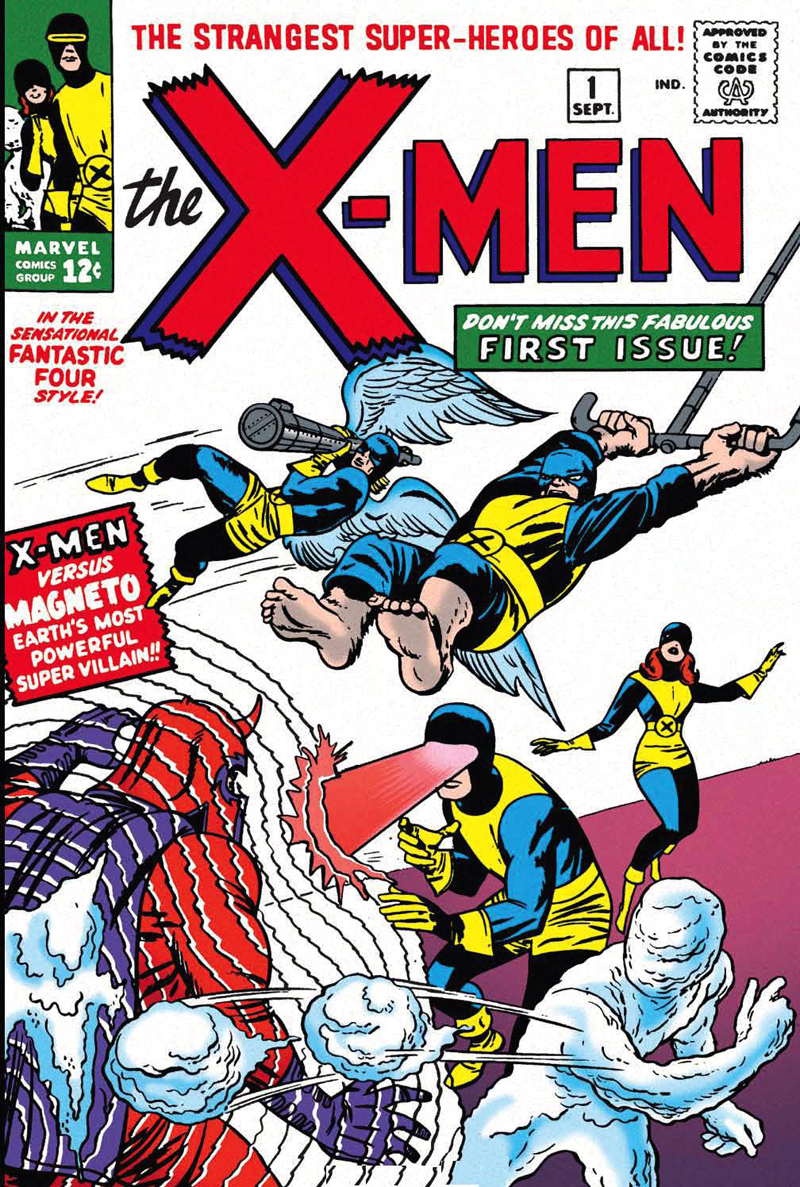
In a recent blog, I talked about the first appearance of the X-Men in 1963 and all-too-breifly touched upon how much they'd changed since then.  And yet, the original, unfiltered X-Men of 1963 (comic book time) had come to the present to shake things up.

© 2013 Marvel Entertainment
This idea couldn't have worked better.

On top of this great arc, the most popular X-Men had a modest success at the box office with The Wolverine, which marked Hugh Jackman's fifth appearance as the character (sixth if you count a cameo in X-Men: First Class) while Famke Janssen also appeared as Jean Grey.  I think of every film superheroine, Janssen as Jean is the greatest, because she had the beauty, poise and grace the role required, with acting chops to back it up; and while they never gave her anything even resembling a familiar costume from the comics, I never felt like it wasn't Jean we were watching.

Marvel's other big-time team obviously also had its share of things to celebrate.  While last year was its major year of achievement, with the enormously successful eponymous film, Iron Man 3, was this year's top-grossing picture, and Thor: the Dark World held its own, so-far coming in at just under $200 million, and proving that a superhero movie can open in November (I honestly can't remember any others that did).

I didn't follow Infinity in the comics, but I have caught a few episodes of the new Avengers Assemble animated series, which ties into the excellent Ultimate Spider-Man show and already has a spinoff called Hulk and the Agents of S.M.A.S.H.  The roster of Avengers Assemble is the same as in the film, but with the addition of Falcon who will appear in Captain America: the Winter Soldier.

© 2013 Marvel Entertainment
And so as we say goodbye to a truly remarkable year, remember: I am right and if you disagree with me, you're wrong; but are free to leave some comments.


© 2013 Marvel Entertainment

Monday, December 16, 2013

The Further Adventures of First Appearances

One of the goals of this blog is to explore the history of comic books, and one of the most important aspects of comic book history is examining the first appearances of the major superheroes.  The characters change over time, and it's not only interesting to see the differences, but it's also important to get a handle of what the original creators intended.

In my last First Appearances blog, I feel I could have delved deeper into examining the five biggest superheroes.  Maybe I'll redo it sometime.  In the meantime, here are the origins of five more superheroes.  Well, actually, four solo superheroes, a couple of their sidekicks, one's mother who later became a superheroine and a team of young superheroes, their mentor, their enemy who later became a member and a brief look at the first appearance of a guy who later joined the team and basically took it over.

But I also want to take a look at how the characters have changed.  That's something I only hinted at in the last superheroes blog, although when talking about those five, we'd probably need an entire blog entry for each of them.

Captain America

Captain America Comics #1


© 1941 Marvel Entertainment
Right off the bat, this issue has the greatest cover of all time.  Just Captain America socking Adolph Hitler.  It's also notable, because I honestly can't think of a superhero before Captain America, who was introduced in his/her own comic.  Yes, the original Flash was introduced in Flash Comics #1, but that was very much an anthology, and you could argue the title wasn't about the character, and that it meant "flash as in "pizzaz."  That said, Captain America Comics #1 (and possibly subsequent issues) include backup stories featuring other heroes, but we don't have to worry about them.

The issue is divided up into four different "cases" outlined on a black and white introductory page.  The story is set in 1941, and it's worth noting that it was released in March, whereas the U.S. didn't officially enter World War II until December of that year. No matter, many Americans felt that we were bound to enter the war, a sentiment which this book echoed.

As we see the effects of NAZI sabotage on or soil, some members of the brass discuss the situation with President Roosevelt, who facetiously suggests, "a character out of the comic books?  Perhaps the Human Torch in the army would solve our problem!"  It's interesting to see the Human Torch talked about as fictional character when Cap would eventually team-up with him.  Also, at the time, you'd think Superman or Captain Marvel would be a bigger part of the lexicon, but of course, why promote the competition?

FDR's flippant remark seems odd, however, as he summons Agent Grover of the F.B.I. to take the officers to a secret location wherein a Professor Reinstein is conducting an experiment.  An experiment in which young Steve Rogers is transformed into Captain America.
© 1941 Marvel Entertainment

Now, Cap's origin should be fairly familiar to most people reading this: he takes the Super Soldier serum, and transforms from a scrawny boy desperate to join the army, to the herculean figure we all know and love.  Then, a NAZI spy who had infiltrated the hideout shoots Reinstein and Grover before Captain America can stop them.  Conveniently, the spy crashes into some equipment while trying to escape, and dies.

Captain America is born!  As the news of the star-spangled avenger reaches the paper, young camp mascot Bucky Barnes marvels at his feats and wishes he could meet the hero.  No sooner does Steve give him the "tut tut, maybe you can one day," speech than Bucky finds him changing, causing him to say, "I ought to tan your hide!"

Instead of just saying, "well, let's keep a secret, he gives Bucky a red & blue costume and lets him fight alongside him.  Here's my biggest problem with Bucky: are we to understand that everybody knows that he's Bucky Barnes, while Steve is supposed to have a secret identity?  Sure, it's not like they have a guardian/ward relationship, but as we'll find out, they're hanging out together an awful lot.

It's obvious Timely (as Marvel was called back then) had big plans for Captain America when they introduced him.  This issue has an ad for a fan club called the Sentinels of Liberty. This approach paid off as he became their biggest star of the golden age, and a hero who has lasted through the ages.

Anyway, we move onto another case in which Captain America and Bucky must foil a fortune-telling act consisting of a duo known as Sando and Omar.  Sando hypnotizes Omar who then projects the image of an explosion at Fort Bix caused by enemy sabotage.

Captain America and Bucky read about the show, and decide to watch it and see what the deal is.  As Omar predicts the destruction of the Hilltown Bridge, Captain America and Bucky spring into action.  As they do, the bridge actually does blow up, they get captured, along with a spy named Betty Ross, a name that would be bestowed on the Hulk's love interest in the years to come.

You can probably guess how the rest of the story goes.

The Red Skull makes his debut in Captain America
Comics
#1, March 1941.
© 1941 Marvel Entertainment
Next, there's a text story called, "Captain America and the Soldiers' Soup."  These text stories were a staple of early comics, and in the third issue, Simon and Kirby's assistant--the publisher's nephew Stan--made his writing debut in such a story.

The next story introduces a villain known as Ratchcone who masterminds the deaths of certain generals and such.  I'm going to skip it, however, because the next story has a similar theme, and it introduces yet another villain: the Red Skull.


Yes, the Red Skull.  It's so interesting to think that in this one issue, we're introduced to the hero, the sidekick and the signature villain.  Yes, the Red Skull would go on to be one of comics' most enduring villains.  His story involves systematically killing off high-ranking members of the U.S. government.  While people believe that he manages to frighten them to death, he's actually injecting his victims with a hypodermic needle.  He also manages to sabotage a plane he's ostensibly selling to the U.S. under his true identity of Mr. Maxon of the Maxon air company.

It's kind-of exhausting talking about this book because there are four stories all told, but it's a fun book to read.  In fact, I'd say that of every book from the golden age, it's the third greatest right after the respective first issues of Superman and Batman (first issues, not first appearances).

Now, in this "first appearances" blog and all future ones, I'd like to talk about what's changed, and with Captain America, the only thing that keeps him from being mostly fully-formed (aside from his shield not being the right shape and some minor costume issues) is just the fact that the story of him being trapped under ice and unearthed decades later is nowhere to be found because that--which has become just as much a part of his origin as anything else--has yet to happen.

For years, the main developments with Captain America concerned his place in the Marvel Universe.  On the one hand, he's the stoic superhero whom others look up to.  On the other hand, more than a couple of times, Marvel has had a story involving Cap. becoming disillusioned by the American government, and striking out on his own.

Captain America never had that much luck in live-action films or animation until recently.  His only cartoon series as a solo hero was one of those dreadful cartoons that involved taking panels and just moving the lips.  In live-action, there was a Captain America serial in the 1940s, but they changed so much (his secret identity, his weapon, a lack of origin, an original villain, no mention of wartime menaces or him actually being in the army, and no Bucky though there was a female sidekick) I honestly think they just took an existing script and slapped the costume on the guy every so often.

Captain America as he appears in today's comics
© 2013 Marvel Entertainment

Captain America's death in 2008 was big news, but part of that was because it wasn't promoted at all and fans learned about it as they were reading the pages of Captain America Vol. 5 #25.  The character was subsequently revived, but it took him a while to reclaim the mantle of Captain America, or so I understand because I haven't followed it in a while.

I should also mention Marvel's Ultimate line, in which alternate versions of the heroes appear.  One day, I will do a super colossal overview of the Ultimate line, but for now, let's just say that that version of Captain America had an impact on the live-action version, the video games (in particular Marvel: Ultimate Alliance) and the current animated incarnation of Cap, Avengers Assemble.  The film Captain America: the First Avenger was, in my opinion, one of the greatest superhero movies of all time, and it lead up to The Avengers wherein Captain America was underused, but well-played by Chris Evans.  I'm looking forward to 2014's Captain America: the Winter Soldier.

Chris Evans in the upcoming Captain America: the Winter Soldier
© 2013 Marvel Entertainment

The Green Arrow

More Fun Comics #73

As you can see, he's not even on the cover.
© 1941 D.C. Entertainment.
That's right: like Captain America's Bucky, Speedy was around from Day 1.  Because of all the sidekicks that came about during this period, I thought about including Robin's first appearance, and if this had come about sometime between 1995 and 2007, maybe I would have.  Anyway, that's beside the point.

A few years ago, if you were to tell me that there would be any argument to be made that Green Arrow would be one of the biggest superheroes on the horizon, I'd have laughed.  Yeah, he's cool, and the political aspects of the early '70s made him more than just "the bow and arrow guy," but he always seemed to be straddling the 2nd and 3rd tier of D.C.'s line of superheroes.  That started to change with Kevin Smith's run on the character and his appearances on Justice League Unlimited and Smallville, and with the current series Arrow, he's achieved a certain level of live-action success where others had failed.  Besides… archery is cool these days.

Stephen Amell as Arrow on the C.W.'s primetime hit.
© Warner Bros
As you may have been able to tell by the cover, this is a back-up feature, in a comic where Dr. Fate's story is
the headliner.  In any case, the deal in this issue is that the Green Arrow and Speedy have to foil a serial killer who murders the namesakes of famous men.  One-after-one, the hooded killer shoots a guy named George Lincoln, hangs a man named John Hale, and stabs an individual named Anthony Caesar.  All of them were members of a history club, and their deaths reach the airwaves, prompting Oliver Queen and his ward Roy Harper into action.

The two explicitly live in an apartment, and it's billed as both of theirs, so I'm a little confused.  Was Roy originally not his ward?  Is he a kid or just kind-of a short guy?

Anyway, despite living in an apartment, there's a "secret garage that harbors the fastest car on wheels--the Arrowplane--a super-streamlined racer capable of amazing speed.  In other-words the Batmobile, but with an arrow theme.  It also has a catapult which enabled him to "fly" unto a window and crash through it Superman-style.
© 1941 D.C. Entertainment.

Not the least bit upset by any of this, the members of the club tell the Green Arrow about how they're marked for having the same last name as famous historical figures.  The man with the last name Achilles boasts that he has metal boots, so he won't injure him through his heel like the hero of Greek myth.  As you may predict, by the time Green Arrow intuits that the killer may somehow use the metal boots to kill the guy, it's too late and he dies right before their eyes.

After this horrendous ordeal, Green Arrow goes undercover, but because he's still wearing his domino mask.  This is one of those old-timey superhero conventions that makes absolutely no sense, nor does it make any sense that they wouldn't… y'know… try to remove his mask.  Also, Speedy was captured and they tied them up together.  Obviously, they manage to escape when Arrow kicked his shoe out through the window.

Anyway, they foil the next two attempts to kill people on the list of men with famous namesakes and it builds to an exciting car chase (by the standards of an early '40s comic book) cumulating in Arrow shooting, well, an arrow into the wheel of the bad guy's car, sending it off the bridge.

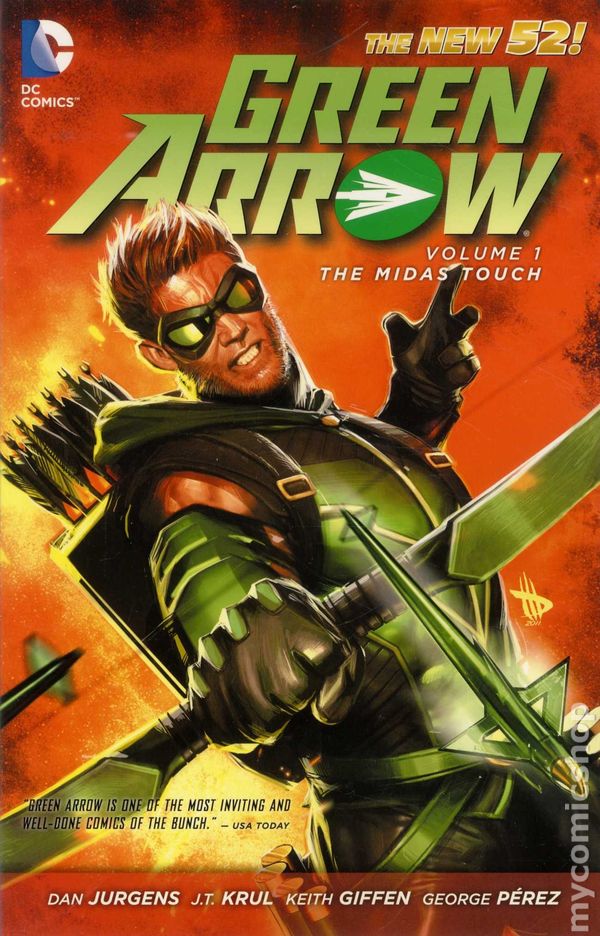
The Green Arrow in his current costume in the comics
© 2011 D.C. Comics
The story ends with Queen putting a bomb the villain was going to use in a souvenir case in his apartment.

Not a bad debut for the character, all things considered.  A typical forgettable comic from the era, and it's a little strange that there's no origin.  But then, what origin do they need?  Our hero shoots criminals with an archery set.

The character's costume in this early stage is somewhat uninspired.  It's really just a green tunic and pants, a domino mask and a Robin Hood hat.  The character comes off incredibly conventional, with very little sense of what was to come.  And there was a lot.

What's also strange is that there isn't much mention of Queen's fortune.  In fact, the only thing that hints at it is the car, of course and the souvenir case.  And even that doesn't mean he's particularly wealthy.  On the other hand, if he was a wealthy, why would he be renting an apartment with a younger guy?  Of course, it wouldn't be too long before the Green Arrow and Speedy were explicitly stated as a guardian and a ward, Oliver Queen was confirmed as a millionaire, and that he'd become such a great archer while marooned on an island.

A pivotal issue from the early '70s.
© 1971 D.C. Entertainment
It's also interesting to note that he was co-created by Mort Weissenger, later a famous (and incredibly controversial) editor for the Superman books.  For the record, the artist was George Papp, as the "creator" credits for superheroes usually go to the writer and artist of their first appearance.

What made the Green Arrow special to a lot of people was that he became an unabashed leftist in the early '70s.  Even if you don't agree with the politics espoused, or find it anvilicious, I think it made the character stand out in D.C.'s stable at a time when they still tended to write their main cast of male heroes (Superman, Batman, Aquaman, the Flash, Green Lantern) somewhat interchangeably.  In fact, during his time as the leftist staple of the Green Lantern books, writers revealed that Speedy had become a heroin-user.

In recent years, D.C. has given the character a more youthful makeover, particularly in the New 52 comics and in his own television series Arrow.  What was once easily one of D.C. Comics' second-stringers has become one of their biggest heroes.  If Arrow can last through a third season, it will have been on TV as long as the television incarnations of Batman and Wonder Woman.

Here's a preview of what's to come on the show.


Wonder Woman

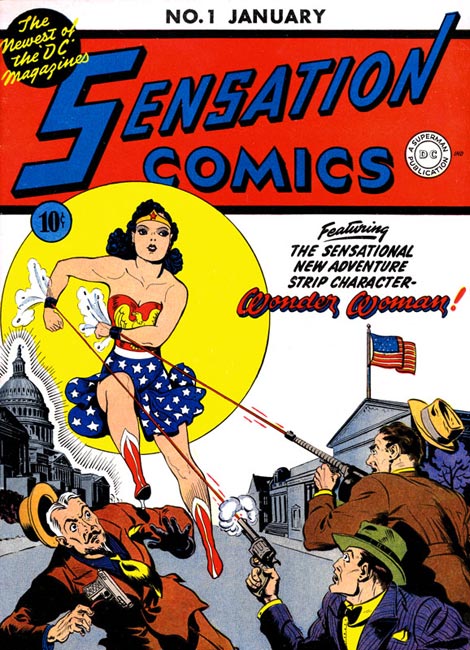
All Star Comics #8/ Sensation Comics #1


Not Wonder Woman's first appearance, but
this image was used in it, and this is her
first cover.
© 1941 D.C. Entertainment


At this point, you may wonder why I'm bothering to do Wonder Woman in this as she hasn't had any success in live action since the late '70s and even her comics haven't sold that well historically (although, the October 2013 issues of Justice League and Wonder Woman are well in the top ten, her solo series came in at #77) and inevitably, the current casting of Gal Gadot is being picked apart; though honestly, I think they could have cast anybody and the asme thing would have happened.  I like her.

My rendering of Gadot as Wonder Woman.
Wonder Woman ™ & © D.C. Entertainment.

But sometimes it's not all about success in other media, and while the claim that Wonder Woman was the first super heroine is simply false, most people at-least seem to know who she is, despite her last live-action adventures well over thirty years ago.

All Star Comics #8 begins with a brief introduction to the character touting how in a world of "the hatreds and wars of men," Wonder Woman is here as if she's here "to avenge an injustice or right a wrong," and that she has "the speed of Mercury and the strength of Hercules."

The story begins with Col. Steve Trevor piloting a plane that crashes on Paradise Island where men are forbidden.  The island's princess known as Diana (yes, Wonder Woman was Princess Diana, we don't need to dwell on that, this was twenty years before the real Princess Diana was born) and her friend rescue the man and take him to the hospital.

I wonder if Madonna was a fan.
© 1941 D.C. Entertainment
Queen Hippolyte walks in and SWEET KATY PERRY, WHAT THE HELL IS SHE WEARING!?!?!  I'm sorry, but the cone bra and really most of the costumes in this comic just kind-of undercut the femocentric message.  Yeah, I know, I've offended some people by saying that Wonder Woman's costume is as stripperific as that of any '90s "bad girl," but it's true.  I mean, no little girl is going to run around in a bathing suit because of it, but it has to be acknowledged that Wonder Woman's creator William Moulton Marston (credited here as Charles Moulton, while artist H.G. Peter doesn't seem to be credited at all) was living in a polyamorous household (basically, he had a wife and they had a mistress) and littered the subsequent comics with bondage images because of some theory about "loving submission."

However, while I think he had a questionable personality, it should be said that the writing in the two issues we're discussing is among the most complex of its day.  It's also interesting to note that he's one of a handful of people in the comic book industry who was born prior to the 20th century.

Any whodilly doodle, Diana confesses that she "loves" the unconscious military man she just encountered, so Hippolyte gives her the lowdown in a couple of mostly-text pages of how she came to be where she is, why men are persona non-grata on the island and how she got a certain magic girdle then apparently being omniscient tells us how Col. Trevor got there thanks to some spies who knocked him out and put him in a plane inside a larger plane and dropped him over the water.

Hippolyte then holds a contest to see who should take the guy back to America in the Invisible Plane and stay there to fight for equal rights while trying to help defeat the evil NAZI forces who have opposed it.  Diana wants to go, but is forbidden, however she enters the tournament and wins, so she gets to go to America and be Wonder Woman to her mother's dismay.
© 1941 D.C. Entertainment

This classic tale of rebellion is told a little fast, but it's an effective origin.  Sadly, in All-Star #8, we don't really see her in action, but in Sensation Comics #1, we do.  I'm mostly going to skirt over it as it's not technically her first appearance anymore; but her origin does continue.  She takes Steve Trevor to an American hospital leaving people bewildered, foils a typical robbery, enters showbiz but quits after realizing Steve is still in the hospital, then in an incredibly contrived moment, meets a young nurse named… lo and behold… Diana Prince who looks just like her.  Ms. Prince laments that her fiancé moved to South America, and they have the brilliant idea that Wonder Woman give her the money she urned doing shows so Diana can fly to be with her beloved, while W.W. assumes her identity, especially since she had trained as a nurse on Paradise Island.

So then Steve sneaks out of the hospital, and goes on a mission.  Just as someone shoots Trevor's plane down, Wonder Woman saves him in the Invisible Plane.  They team up, and defeat some bad guys, then he heads back to the hospital where Diana is his nurse and thus begins the exploits of the world's greatest super heroine.

Now, there are many moments in this comic where if I were some self-proclaimed "feminist" who fumes over skimpy superheroine outfits and smarmy dialogue/narration and dressed like Indiana Jones for some reason, I'd probably think this was the worst comic book ever printed.  But I'm not so I just kind-of roll my eyes at that stuff, while acknowledging that for 1941, it's actually very well-written.

As with other long-running superheroes, Wonder Woman has gone through an unending cycle of changes.  In 1968, Dennis O'Neil attempted to revamp Wonder Woman by taking away her powers and costume and just making her a more generic spy heroine.  To say it was a disaster would be an understatement.  Soon after, they made Batman's adventures darker and more streetwise to great effect, and not long after that, attempted to bring Superman's power level down which had mixed results.  It was a new age for superheroes, but D.C.'s preeminent superhero and superheroine just didn't seem to get it right.

Lynda Carter as Wonder Woman
© Warner Bros


However, by the late '70s, things were looking up for the two of them as the Super Friends animated series gained popularity a Wonder Woman T.V. series materialized with Lynda Carter in the title role, while Superman streaked across the big screen played by Christopher Reeve, yet while Superman's comics have had their ups and downs over the years, Wonder Woman's sales have often been disappointing.

This despite a terrific 1987 reboot by George Pérez, who is not only one of comics' great artists, but I think a very underrated writer.  The books went back to the idea of having a feminist message while not being overly preachy and tackling topical issues; while emerging the heroine in Greek mythology (rather than the mixed mythology of earlier comics) and pitting her against more myth-inspired villains.  Other writers and artists came and went since then, and it never really flew off the shelves.

© 1987 D.C. Entertainment
The current comics are also excellent with a more gothic look to them.  They're interesting, if a little bizarre sometimes, but the character's main notability seems to come from her membership in the Justice League and a relationship with Superman (in the New 52 version, he was never married to Lois Lane) which seems to fit with the idea that while most people have heard of Wonder Woman, they don't know or care much about the actual stories.

© 2011 D.C. Entertainment
While the follow-up to Man of Steel was at first talked about as a "Superman Vs Batman" movie, the inclusion of Wonder Woman has lead some to speculate that it's a Justice League film.  Really, the character seems to have become primarily seen as a Justice League member almost to the point where that's eclipsed her reputation as a solo super heroine.  That may not be the worst thing in the world, but for a character D.C. regularly bandies about as being part of a triad that also includes the two greatest, most influential superheroes, it's kind-of a shame and it gives the "if I were running D.C…" crowd plenty of ammo.
Finally, a new Justice League animated film--based on the ever-bollyhooed 2011 reboot--hits shelves February 4, 2014, and Wonder Woman will appear in a variation of her new costume.


Thor

Journey Into Mystery


© 1962 Marvel Entertainment
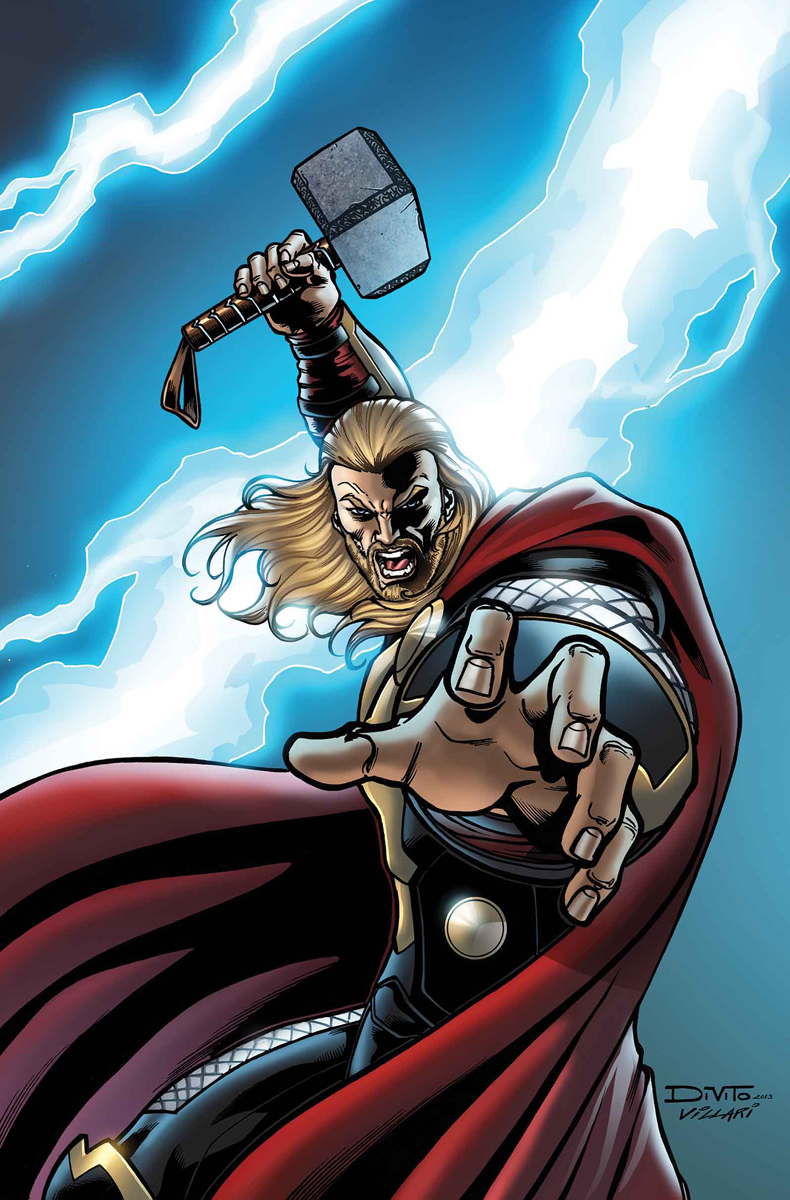
Thor's debut in August 1962 came the same month as Spider-Man's, cementing what we now call the Marvel universe.  Before these two heroes premiered, Marvel had a rag-tag team of superheroes, and a strange superhero-of-sorts who owed more to Frankenstein and the Wolf Man than Superman and Batman.

Thor was based on the Norse god of thunder, but it's just that: based on.  The Thor of Norse mythology didn't wear a long, red cape or have long, blonde hair.  He was a red-haired Viking warrior who didn't fly by the use of his hammer, but his chariot.  This also wasn't the first time we saw a version of Thor in the comics.  Thor may have his roots in Norse myth, but he's a Stan Lee & Jack Kirby creation through-and-through as the title "Thor: the Mighty!  and the Stone Men from Saturn," surely indicates.

During a visit to Norway, the "frail" Dr. Donald Blake is the only person who believes an old man who claims to have seen some stone-like creatures come out of a spaceship and vaporize a tree.  Blake does some investigating and finds the stone men whose attention he unwittingly garners while trying to escape.
© 1962 Marvel Entertainment
He falls almost to his doom, losing his cane along the way, and crawls into a cave wherein he finds a wooden cane and decides to tap a giant boulder.  Suddenly, the cane transforms into a hammer and he takes the form of Thor, the Norse deity who represents thunder.  He finds that he now has the strength to lift the boulder as if it were cardboard.  He also finds that if he lets go of the hammer, he ceases to be Thor and loses his powers, although he can hurl it and it will return.  On top of that, he learns he can create snow, rain, lightning, etc. and he can even tap the hammer to turn back into Blake and turn the hammer back into a cane.

Meanwhile, NATO forces come after the stone men in fighter jets, but the stone men create a hologram of a dragon which frightens the pilots so they parachute out of their planes.  Sometimes I wonder what old Stan had in mind when he got these ideas.
The origin of Thor
© 1962 Marvel Entertainment

Now, the ending is pretty basic: he just shows up and kicks their asses.  But the whole thing is just so random, it's a joy to read.  This issue came out the same month as Amazing Fantasy #15, and it's interesting to think that Marvel had more faith in Thor, for reasons which are fairly obvious.  He had a more traditional superhero look, and I'd even offer that there may have been some inspiration from Captain Marvel--once one of the most popular superheroes of them all, but seemingly relegated to the ash heap of history by this point--in that you had an underdog who magically becomes another being.

And yet, while the origin of Spider-Man was as down-to-Earth as a superhero origin (or story of any kind) had been in a long time, Thor was as outlandish and out-there as you could get.  Yes, about half a year after slopping Spider-Man off into the dying anthology that was Amazing Fantasy, they brought him back in The Amazing Spider-Man #1 and he became Marvel's signature superhero even when other Marvel heroes eclipsed him from time to time (Hulk in the late '70s, the X-Men in the early '90s, Iron Man these days) but the success of Thor: the Dark World shows that the Prince of Thunder has an appeal.

Thor in the recent "Crown of Fools"
© 2013 Marvel Entertainment
Having not particularly followed Thor, the biggest difference I see is that it looks like they've more-or-less done away with Don Blake.  I can understand that, I mean, it's fascinating enough on its own, but it was kind-of a cool idea in keeping with the notion that these meek guys could secretly be superheroes.


Thor: the Dark World wasn't quite the hit that Iron Man 3 or Man of Steel was, but it's keeping the Marvel banner alive and it proves that they can open a November film and it can do okay.


X-Men

X-Men #1

© 1963 Marvel Entertainment
Now, for the third comic on this list drawn by Jack Kirby and the second one written by Stan Lee.

I was actually going to do Wolverine's first appearance in The Incredible Hulk #181 (yes, technically, his first appearance was in #180, but from what I understand it was one panel) but I had a Hell of a time trying to find a reprint of it and when I was talking about it at my local comic book store, the guy said the owner had unloaded it for $2,000 so it's a bit out of my price range.  I had also wanted to do a "firsts" installment on various original teams (original as opposed to the Justice League or the Avengers where they were comprised of existing heroes) and the X-Men may be the most popular of all.

But seeing as how I have the first issue of X-Men (later retitled The Uncanny X-Men) and it's their 50th anniversary, this is more timely.  Besides, during their big five-oh, Marvel saw fit to bring back the original five and proved that Cyclops, Marvel Girl, Iceman, Beast and Angel--as the teenagers they first appeared as--still rock and that's an important thing to remember as all-too-often, people still write them off as a poor man's Fantastic Four.

Before we begin, here's Wolverine's first appearance eleven years after the original team's introduction.

© 1974 Marvel Entertainment
There, that's it.  But while I've looked at The Incredible Hulk #181 in a collection and online (the first few pages of it anyway), I don't own a copy and can't find one, but since these two panels comrpise his first appearance as far as I know, there is the first dialogue spoken by him and the first illustration of him.  Cat-like mask but otherwise the same costume as he had in the late '70s and the '90s.  And yes, he's got an attitude and his trademark claws.  That's all the information we get, and from what I've seen in my Marvel Masterworks: the Uncanny X-Men, that's all we see for a while.

But we're not talking about him today.

Nope, the story starts out with a training session between the four male members of the X-Men.  Of course the name X-Men implies that they're all male, but in this issue, we also meet one of the greatest super heroines of all time.  She's given a code name, Marvel Girl, but by the '90s, she was better known by her given name: Jean Grey.

Interestingly, many introductory installments of the X-Men focus on a female member joining the team, whether it's Jean in this issue, Kitty in Pryde of the X-Men, Jubilee in the first episode of the classic '90s series, Rogue in the first movie, or Magma in the first X-Men: Legends game.

One of the most interesting things fans have noticed about the early X-Men is that Beast is played as something of a "palooka" (in the words of podcaster Michael Bailey) which was common for the super-strong Marvel heroes.  First, there was the Thing from Fantastic Four, then the Hulk.  Within a few issues, however, Stan seemed to want to bring the character in a different direction.  After-all, why does the strong guy have to be the brute as well?  Why not a super-strong character who's also intelligent and studious?

From left: Beast, Iceman, Cyclops, Marvel Girl and Angel
© 2013 Marvel Entertainment
The rest of the characters' personalities mirror the Fantastic Four as well.  Iceman is the young guy like the Human Torch, though trading in the James Dean attitude for more of a prankster motive.  Jean Grey was the beautiful and intelligent but naïve young woman that Invisible Girl was and Cyclops was a stone-faced leader in the vain of Mr. Fantastic, though without the scientific acumen and a way cooler power, and yet, the Angel was a bit of an aristocrat and fairly arrogant, so I guess that would make him the Sub-Marriner, given that the next few issues would have a bit of a love-triangle between the three of them.

After we're introduced to our teen heroes, we transition over to Magneto, who is busy taking over a military base.  Like I said, Jean Grey may be the greatest super heroine of all time, and similarly, Magneto may be the greatest super villain of all time.  Not only does he have the power to manipulate the magnetic field and all objects made of metal (a particularly lethal power when Wolverine and Colossus joined the team) but the way he saw himself as the true hero, at first simply hating humans and wanting to exterminate them.  As the series rolled on, the idea that the X-Men were feared and hated by normal humans became a major theme, and Magneto's role was that of a sort-of radical who wanted his people--the mutants--to take over the world after being oppressed.

© 1963 Marvel Entertainment
Back at the X-Mansion, Jean puts on her costume while the other X-Men sneak in and ogle her, except for Cyclops, (her future husband as it turned out).  Then, they're interrupted by the news that Magneto is attacking a base, so they take a Rolls Royce to a secret hangar and board their own private jet to get to the base Magneto took over.

© 1963 Marvel Entertainment
Cyclops get knocked out blasting Magneto's force field but Magneto launches a bunch of missiles.  Angel draws their fire, but Iceman freezes some of them, while Beast grabs one with his feet and Marvel Girl uses her telekinesis to move one into the ocean.  Magneto tries one last-ditch attempt at destroying them by forcing a cart full of rocket fuel at them, but Ice Man covers them up with an ice shield and they force the villain to retreat.

The army is grateful to for their help, but that gratitude is eventually whisked away as the concept that normal people hate and fear mutants--the race to which the X-Men belong--and the series is used as a metaphor for battling racism.

So how have the X-Men changed over the years?  Well, at first, it just came down to adding the occasional new members and supporting characters, with even enemies turning into allies.  They were also sometimes rewarded with their own individually-designed costumes.  But then, the book was cancelled, although Marvel kept publishing it, using reprints of older stories.

So that was that, right?

Well, does this look familiar?

© 1975 Marvel Entertainment


How' bout this?


Or this?


Or this?

© 2002 Marvel Entertainment


Or this?


The X-Men have probably had more personal changes than any original team, and debatably more than even teams like the Justice League and the Avengers.  It's hard to even pick what the definitive team would be, but again, the most essential member doesn't seem to be one of the original five, it seems to be Wolverine.  He was the first to get his own series, and his own solo films.

Another mid-'70s addition to the team who's proven invaluable was Storm, who's possibly the most famous black superhero of all time, and rivals Wonder Woman as the most beloved superheroine.  In fact, she defeated Wonder Woman in the 1996 miniseries Marvel Vs D.C. which was, let's face it, a glorified popularity contest.  Not only that, but playing Storm seemed to move Halle Berry's career up a notch, even though her role in the first film was somewhat small and utilitarian.

Storm, Wolverine and Cyclops seemed, for a while, to form a "big three" for the team, the way Superman, Batman and Wonder Woman did for the Justice League or Captain America, Iron Man and Thor did for the Avengers: the team could go through any number of line-up changes, but the nucleus of the team being intact was so all-important that without them, it just didn't feel right, although after a while, that just stopped being the case.

Back to Cyclops and the other original five.  In 1982, Cyclops finally left the team after the other original four had quit years earlier (in fact, Jean died but it turned out to be a clone, while the real Jean was… you know, I honestly don't understand either).  The original X-Men returned, however, in 1986's X-Factor series, in brand new costumes.  This lasted a number of years, but the 1991 revamp of the team and ensuing towline, video games and animated series marked not only a growing interest among comic book readers, but an explosion of the characters in popular culture in general.  All of this before the 2000 film X-Men ushered in a new generation of superhero films.

© 1986 Marvel Entertainment


Days of Future Past, based extremely loosely on a pivotal two-parter from the 1980s, will hit theaters in 2014.  In this trailer, we can see Professor X, Magneto, Beast and I think Iceman are there, and Jean Grey appeared in this year's The Wolverine, but I don't think Cyclops is coming back.


Meanwhile, the original team has returned.  Starting this year, All-New X-Men saw the blue, furry Beast bringing the original team back from the past in an effort to talk some sense into Cyclops who had teamed with Magneto and become a militant mutant himself.  It backfired and as of this entry, the original team has joined the older Cyclops' faction.  How it plays out is anybody's guess because if there's one thing the X-Men aren't, it's predictable.

When it comes to the irreverence that makes
teen heroes so appealing, the original
X-Men still got it.
© 2013 Marvel Entertainment