Monday, December 16, 2013

The Further Adventures of First Appearances

One of the goals of this blog is to explore the history of comic books, and one of the most important aspects of comic book history is examining the first appearances of the major superheroes.  The characters change over time, and it's not only interesting to see the differences, but it's also important to get a handle of what the original creators intended.

In my last First Appearances blog, I feel I could have delved deeper into examining the five biggest superheroes.  Maybe I'll redo it sometime.  In the meantime, here are the origins of five more superheroes.  Well, actually, four solo superheroes, a couple of their sidekicks, one's mother who later became a superheroine and a team of young superheroes, their mentor, their enemy who later became a member and a brief look at the first appearance of a guy who later joined the team and basically took it over.

But I also want to take a look at how the characters have changed.  That's something I only hinted at in the last superheroes blog, although when talking about those five, we'd probably need an entire blog entry for each of them.

Captain America

Captain America Comics #1


© 1941 Marvel Entertainment
Right off the bat, this issue has the greatest cover of all time.  Just Captain America socking Adolph Hitler.  It's also notable, because I honestly can't think of a superhero before Captain America, who was introduced in his/her own comic.  Yes, the original Flash was introduced in Flash Comics #1, but that was very much an anthology, and you could argue the title wasn't about the character, and that it meant "flash as in "pizzaz."  That said, Captain America Comics #1 (and possibly subsequent issues) include backup stories featuring other heroes, but we don't have to worry about them.

The issue is divided up into four different "cases" outlined on a black and white introductory page.  The story is set in 1941, and it's worth noting that it was released in March, whereas the U.S. didn't officially enter World War II until December of that year. No matter, many Americans felt that we were bound to enter the war, a sentiment which this book echoed.

As we see the effects of NAZI sabotage on or soil, some members of the brass discuss the situation with President Roosevelt, who facetiously suggests, "a character out of the comic books?  Perhaps the Human Torch in the army would solve our problem!"  It's interesting to see the Human Torch talked about as fictional character when Cap would eventually team-up with him.  Also, at the time, you'd think Superman or Captain Marvel would be a bigger part of the lexicon, but of course, why promote the competition?

FDR's flippant remark seems odd, however, as he summons Agent Grover of the F.B.I. to take the officers to a secret location wherein a Professor Reinstein is conducting an experiment.  An experiment in which young Steve Rogers is transformed into Captain America.
© 1941 Marvel Entertainment

Now, Cap's origin should be fairly familiar to most people reading this: he takes the Super Soldier serum, and transforms from a scrawny boy desperate to join the army, to the herculean figure we all know and love.  Then, a NAZI spy who had infiltrated the hideout shoots Reinstein and Grover before Captain America can stop them.  Conveniently, the spy crashes into some equipment while trying to escape, and dies.

Captain America is born!  As the news of the star-spangled avenger reaches the paper, young camp mascot Bucky Barnes marvels at his feats and wishes he could meet the hero.  No sooner does Steve give him the "tut tut, maybe you can one day," speech than Bucky finds him changing, causing him to say, "I ought to tan your hide!"

Instead of just saying, "well, let's keep a secret, he gives Bucky a red & blue costume and lets him fight alongside him.  Here's my biggest problem with Bucky: are we to understand that everybody knows that he's Bucky Barnes, while Steve is supposed to have a secret identity?  Sure, it's not like they have a guardian/ward relationship, but as we'll find out, they're hanging out together an awful lot.

It's obvious Timely (as Marvel was called back then) had big plans for Captain America when they introduced him.  This issue has an ad for a fan club called the Sentinels of Liberty. This approach paid off as he became their biggest star of the golden age, and a hero who has lasted through the ages.

Anyway, we move onto another case in which Captain America and Bucky must foil a fortune-telling act consisting of a duo known as Sando and Omar.  Sando hypnotizes Omar who then projects the image of an explosion at Fort Bix caused by enemy sabotage.

Captain America and Bucky read about the show, and decide to watch it and see what the deal is.  As Omar predicts the destruction of the Hilltown Bridge, Captain America and Bucky spring into action.  As they do, the bridge actually does blow up, they get captured, along with a spy named Betty Ross, a name that would be bestowed on the Hulk's love interest in the years to come.

You can probably guess how the rest of the story goes.

The Red Skull makes his debut in Captain America
Comics
#1, March 1941.
© 1941 Marvel Entertainment
Next, there's a text story called, "Captain America and the Soldiers' Soup."  These text stories were a staple of early comics, and in the third issue, Simon and Kirby's assistant--the publisher's nephew Stan--made his writing debut in such a story.

The next story introduces a villain known as Ratchcone who masterminds the deaths of certain generals and such.  I'm going to skip it, however, because the next story has a similar theme, and it introduces yet another villain: the Red Skull.


Yes, the Red Skull.  It's so interesting to think that in this one issue, we're introduced to the hero, the sidekick and the signature villain.  Yes, the Red Skull would go on to be one of comics' most enduring villains.  His story involves systematically killing off high-ranking members of the U.S. government.  While people believe that he manages to frighten them to death, he's actually injecting his victims with a hypodermic needle.  He also manages to sabotage a plane he's ostensibly selling to the U.S. under his true identity of Mr. Maxon of the Maxon air company.

It's kind-of exhausting talking about this book because there are four stories all told, but it's a fun book to read.  In fact, I'd say that of every book from the golden age, it's the third greatest right after the respective first issues of Superman and Batman (first issues, not first appearances).
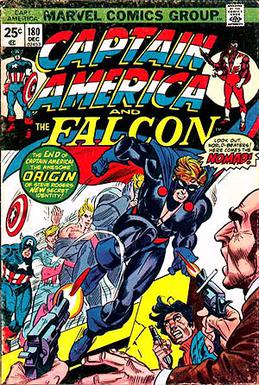
Now, in this "first appearances" blog and all future ones, I'd like to talk about what's changed, and with Captain America, the only thing that keeps him from being mostly fully-formed (aside from his shield not being the right shape and some minor costume issues) is just the fact that the story of him being trapped under ice and unearthed decades later is nowhere to be found because that--which has become just as much a part of his origin as anything else--has yet to happen.

For years, the main developments with Captain America concerned his place in the Marvel Universe.  On the one hand, he's the stoic superhero whom others look up to.  On the other hand, more than a couple of times, Marvel has had a story involving Cap. becoming disillusioned by the American government, and striking out on his own.

Captain America never had that much luck in live-action films or animation until recently.  His only cartoon series as a solo hero was one of those dreadful cartoons that involved taking panels and just moving the lips.  In live-action, there was a Captain America serial in the 1940s, but they changed so much (his secret identity, his weapon, a lack of origin, an original villain, no mention of wartime menaces or him actually being in the army, and no Bucky though there was a female sidekick) I honestly think they just took an existing script and slapped the costume on the guy every so often.

Captain America as he appears in today's comics
© 2013 Marvel Entertainment

Captain America's death in 2008 was big news, but part of that was because it wasn't promoted at all and fans learned about it as they were reading the pages of Captain America Vol. 5 #25.  The character was subsequently revived, but it took him a while to reclaim the mantle of Captain America, or so I understand because I haven't followed it in a while.

I should also mention Marvel's Ultimate line, in which alternate versions of the heroes appear.  One day, I will do a super colossal overview of the Ultimate line, but for now, let's just say that that version of Captain America had an impact on the live-action version, the video games (in particular Marvel: Ultimate Alliance) and the current animated incarnation of Cap, Avengers Assemble.  The film Captain America: the First Avenger was, in my opinion, one of the greatest superhero movies of all time, and it lead up to The Avengers wherein Captain America was underused, but well-played by Chris Evans.  I'm looking forward to 2014's Captain America: the Winter Soldier.

Chris Evans in the upcoming Captain America: the Winter Soldier
© 2013 Marvel Entertainment

The Green Arrow

More Fun Comics #73

As you can see, he's not even on the cover.
© 1941 D.C. Entertainment.
That's right: like Captain America's Bucky, Speedy was around from Day 1.  Because of all the sidekicks that came about during this period, I thought about including Robin's first appearance, and if this had come about sometime between 1995 and 2007, maybe I would have.  Anyway, that's beside the point.

A few years ago, if you were to tell me that there would be any argument to be made that Green Arrow would be one of the biggest superheroes on the horizon, I'd have laughed.  Yeah, he's cool, and the political aspects of the early '70s made him more than just "the bow and arrow guy," but he always seemed to be straddling the 2nd and 3rd tier of D.C.'s line of superheroes.  That started to change with Kevin Smith's run on the character and his appearances on Justice League Unlimited and Smallville, and with the current series Arrow, he's achieved a certain level of live-action success where others had failed.  Besides… archery is cool these days.

Stephen Amell as Arrow on the C.W.'s primetime hit.
© Warner Bros
As you may have been able to tell by the cover, this is a back-up feature, in a comic where Dr. Fate's story is
the headliner.  In any case, the deal in this issue is that the Green Arrow and Speedy have to foil a serial killer who murders the namesakes of famous men.  One-after-one, the hooded killer shoots a guy named George Lincoln, hangs a man named John Hale, and stabs an individual named Anthony Caesar.  All of them were members of a history club, and their deaths reach the airwaves, prompting Oliver Queen and his ward Roy Harper into action.

The two explicitly live in an apartment, and it's billed as both of theirs, so I'm a little confused.  Was Roy originally not his ward?  Is he a kid or just kind-of a short guy?

Anyway, despite living in an apartment, there's a "secret garage that harbors the fastest car on wheels--the Arrowplane--a super-streamlined racer capable of amazing speed.  In other-words the Batmobile, but with an arrow theme.  It also has a catapult which enabled him to "fly" unto a window and crash through it Superman-style.
© 1941 D.C. Entertainment.

Not the least bit upset by any of this, the members of the club tell the Green Arrow about how they're marked for having the same last name as famous historical figures.  The man with the last name Achilles boasts that he has metal boots, so he won't injure him through his heel like the hero of Greek myth.  As you may predict, by the time Green Arrow intuits that the killer may somehow use the metal boots to kill the guy, it's too late and he dies right before their eyes.

After this horrendous ordeal, Green Arrow goes undercover, but because he's still wearing his domino mask.  This is one of those old-timey superhero conventions that makes absolutely no sense, nor does it make any sense that they wouldn't… y'know… try to remove his mask.  Also, Speedy was captured and they tied them up together.  Obviously, they manage to escape when Arrow kicked his shoe out through the window.

Anyway, they foil the next two attempts to kill people on the list of men with famous namesakes and it builds to an exciting car chase (by the standards of an early '40s comic book) cumulating in Arrow shooting, well, an arrow into the wheel of the bad guy's car, sending it off the bridge.
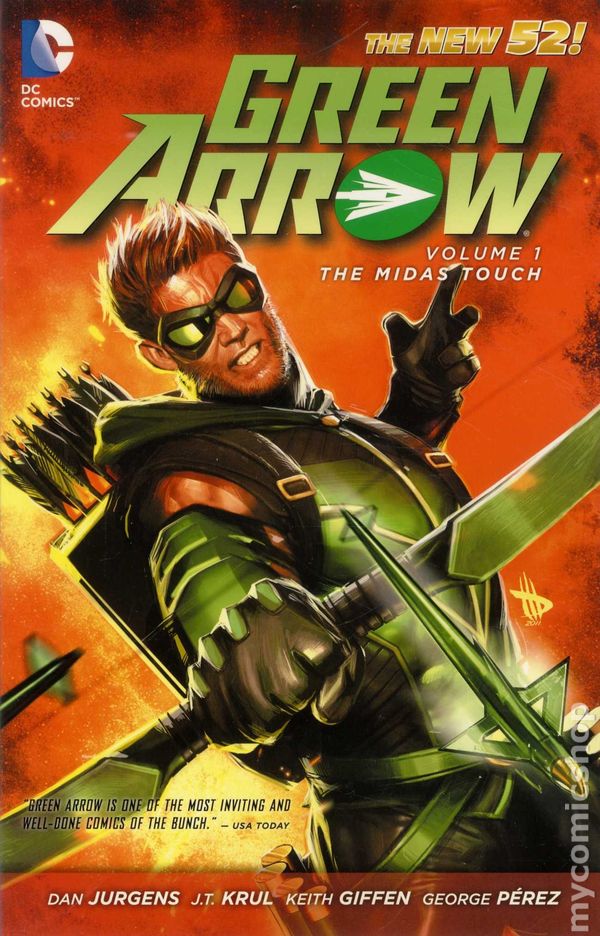
The Green Arrow in his current costume in the comics
© 2011 D.C. Comics
The story ends with Queen putting a bomb the villain was going to use in a souvenir case in his apartment.

Not a bad debut for the character, all things considered.  A typical forgettable comic from the era, and it's a little strange that there's no origin.  But then, what origin do they need?  Our hero shoots criminals with an archery set.

The character's costume in this early stage is somewhat uninspired.  It's really just a green tunic and pants, a domino mask and a Robin Hood hat.  The character comes off incredibly conventional, with very little sense of what was to come.  And there was a lot.

What's also strange is that there isn't much mention of Queen's fortune.  In fact, the only thing that hints at it is the car, of course and the souvenir case.  And even that doesn't mean he's particularly wealthy.  On the other hand, if he was a wealthy, why would he be renting an apartment with a younger guy?  Of course, it wouldn't be too long before the Green Arrow and Speedy were explicitly stated as a guardian and a ward, Oliver Queen was confirmed as a millionaire, and that he'd become such a great archer while marooned on an island.

A pivotal issue from the early '70s.
© 1971 D.C. Entertainment
It's also interesting to note that he was co-created by Mort Weissenger, later a famous (and incredibly controversial) editor for the Superman books.  For the record, the artist was George Papp, as the "creator" credits for superheroes usually go to the writer and artist of their first appearance.

What made the Green Arrow special to a lot of people was that he became an unabashed leftist in the early '70s.  Even if you don't agree with the politics espoused, or find it anvilicious, I think it made the character stand out in D.C.'s stable at a time when they still tended to write their main cast of male heroes (Superman, Batman, Aquaman, the Flash, Green Lantern) somewhat interchangeably.  In fact, during his time as the leftist staple of the Green Lantern books, writers revealed that Speedy had become a heroin-user.

In recent years, D.C. has given the character a more youthful makeover, particularly in the New 52 comics and in his own television series Arrow.  What was once easily one of D.C. Comics' second-stringers has become one of their biggest heroes.  If Arrow can last through a third season, it will have been on TV as long as the television incarnations of Batman and Wonder Woman.

Here's a preview of what's to come on the show.


Wonder Woman

All Star Comics #8/ Sensation Comics #1
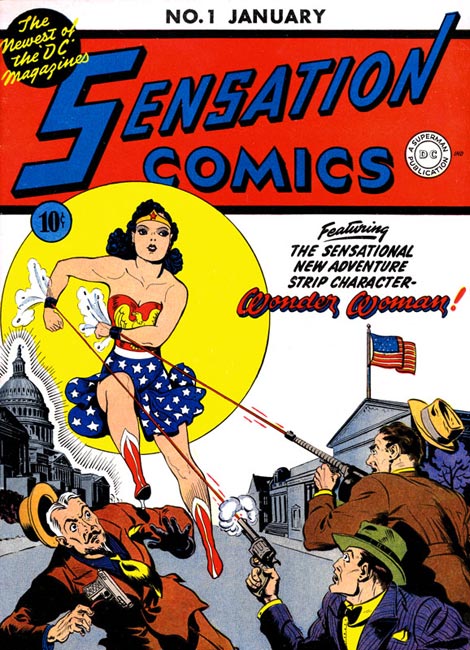


Not Wonder Woman's first appearance, but
this image was used in it, and this is her
first cover.
© 1941 D.C. Entertainment


At this point, you may wonder why I'm bothering to do Wonder Woman in this as she hasn't had any success in live action since the late '70s and even her comics haven't sold that well historically (although, the October 2013 issues of Justice League and Wonder Woman are well in the top ten, her solo series came in at #77) and inevitably, the current casting of Gal Gadot is being picked apart; though honestly, I think they could have cast anybody and the asme thing would have happened.  I like her.

My rendering of Gadot as Wonder Woman.
Wonder Woman ™ & © D.C. Entertainment.

But sometimes it's not all about success in other media, and while the claim that Wonder Woman was the first super heroine is simply false, most people at-least seem to know who she is, despite her last live-action adventures well over thirty years ago.

All Star Comics #8 begins with a brief introduction to the character touting how in a world of "the hatreds and wars of men," Wonder Woman is here as if she's here "to avenge an injustice or right a wrong," and that she has "the speed of Mercury and the strength of Hercules."

The story begins with Col. Steve Trevor piloting a plane that crashes on Paradise Island where men are forbidden.  The island's princess known as Diana (yes, Wonder Woman was Princess Diana, we don't need to dwell on that, this was twenty years before the real Princess Diana was born) and her friend rescue the man and take him to the hospital.

I wonder if Madonna was a fan.
© 1941 D.C. Entertainment
Queen Hippolyte walks in and SWEET KATY PERRY, WHAT THE HELL IS SHE WEARING!?!?!  I'm sorry, but the cone bra and really most of the costumes in this comic just kind-of undercut the femocentric message.  Yeah, I know, I've offended some people by saying that Wonder Woman's costume is as stripperific as that of any '90s "bad girl," but it's true.  I mean, no little girl is going to run around in a bathing suit because of it, but it has to be acknowledged that Wonder Woman's creator William Moulton Marston (credited here as Charles Moulton, while artist H.G. Peter doesn't seem to be credited at all) was living in a polyamorous household (basically, he had a wife and they had a mistress) and littered the subsequent comics with bondage images because of some theory about "loving submission."

However, while I think he had a questionable personality, it should be said that the writing in the two issues we're discussing is among the most complex of its day.  It's also interesting to note that he's one of a handful of people in the comic book industry who was born prior to the 20th century.

Any whodilly doodle, Diana confesses that she "loves" the unconscious military man she just encountered, so Hippolyte gives her the lowdown in a couple of mostly-text pages of how she came to be where she is, why men are persona non-grata on the island and how she got a certain magic girdle then apparently being omniscient tells us how Col. Trevor got there thanks to some spies who knocked him out and put him in a plane inside a larger plane and dropped him over the water.

Hippolyte then holds a contest to see who should take the guy back to America in the Invisible Plane and stay there to fight for equal rights while trying to help defeat the evil NAZI forces who have opposed it.  Diana wants to go, but is forbidden, however she enters the tournament and wins, so she gets to go to America and be Wonder Woman to her mother's dismay.
© 1941 D.C. Entertainment

This classic tale of rebellion is told a little fast, but it's an effective origin.  Sadly, in All-Star #8, we don't really see her in action, but in Sensation Comics #1, we do.  I'm mostly going to skirt over it as it's not technically her first appearance anymore; but her origin does continue.  She takes Steve Trevor to an American hospital leaving people bewildered, foils a typical robbery, enters showbiz but quits after realizing Steve is still in the hospital, then in an incredibly contrived moment, meets a young nurse named… lo and behold… Diana Prince who looks just like her.  Ms. Prince laments that her fiancé moved to South America, and they have the brilliant idea that Wonder Woman give her the money she urned doing shows so Diana can fly to be with her beloved, while W.W. assumes her identity, especially since she had trained as a nurse on Paradise Island.

So then Steve sneaks out of the hospital, and goes on a mission.  Just as someone shoots Trevor's plane down, Wonder Woman saves him in the Invisible Plane.  They team up, and defeat some bad guys, then he heads back to the hospital where Diana is his nurse and thus begins the exploits of the world's greatest super heroine.

Now, there are many moments in this comic where if I were some self-proclaimed "feminist" who fumes over skimpy superheroine outfits and smarmy dialogue/narration and dressed like Indiana Jones for some reason, I'd probably think this was the worst comic book ever printed.  But I'm not so I just kind-of roll my eyes at that stuff, while acknowledging that for 1941, it's actually very well-written.

As with other long-running superheroes, Wonder Woman has gone through an unending cycle of changes.  In 1968, Dennis O'Neil attempted to revamp Wonder Woman by taking away her powers and costume and just making her a more generic spy heroine.  To say it was a disaster would be an understatement.  Soon after, they made Batman's adventures darker and more streetwise to great effect, and not long after that, attempted to bring Superman's power level down which had mixed results.  It was a new age for superheroes, but D.C.'s preeminent superhero and superheroine just didn't seem to get it right.

Lynda Carter as Wonder Woman
© Warner Bros


However, by the late '70s, things were looking up for the two of them as the Super Friends animated series gained popularity a Wonder Woman T.V. series materialized with Lynda Carter in the title role, while Superman streaked across the big screen played by Christopher Reeve, yet while Superman's comics have had their ups and downs over the years, Wonder Woman's sales have often been disappointing.

This despite a terrific 1987 reboot by George Pérez, who is not only one of comics' great artists, but I think a very underrated writer.  The books went back to the idea of having a feminist message while not being overly preachy and tackling topical issues; while emerging the heroine in Greek mythology (rather than the mixed mythology of earlier comics) and pitting her against more myth-inspired villains.  Other writers and artists came and went since then, and it never really flew off the shelves.

© 1987 D.C. Entertainment
The current comics are also excellent with a more gothic look to them.  They're interesting, if a little bizarre sometimes, but the character's main notability seems to come from her membership in the Justice League and a relationship with Superman (in the New 52 version, he was never married to Lois Lane) which seems to fit with the idea that while most people have heard of Wonder Woman, they don't know or care much about the actual stories.

© 2011 D.C. Entertainment
While the follow-up to Man of Steel was at first talked about as a "Superman Vs Batman" movie, the inclusion of Wonder Woman has lead some to speculate that it's a Justice League film.  Really, the character seems to have become primarily seen as a Justice League member almost to the point where that's eclipsed her reputation as a solo super heroine.  That may not be the worst thing in the world, but for a character D.C. regularly bandies about as being part of a triad that also includes the two greatest, most influential superheroes, it's kind-of a shame and it gives the "if I were running D.C…" crowd plenty of ammo.
Finally, a new Justice League animated film--based on the ever-bollyhooed 2011 reboot--hits shelves February 4, 2014, and Wonder Woman will appear in a variation of her new costume.


Thor

Journey Into Mystery


© 1962 Marvel Entertainment
Thor's debut in August 1962 came the same month as Spider-Man's, cementing what we now call the Marvel universe.  Before these two heroes premiered, Marvel had a rag-tag team of superheroes, and a strange superhero-of-sorts who owed more to Frankenstein and the Wolf Man than Superman and Batman.

Thor was based on the Norse god of thunder, but it's just that: based on.  The Thor of Norse mythology didn't wear a long, red cape or have long, blonde hair.  He was a red-haired Viking warrior who didn't fly by the use of his hammer, but his chariot.  This also wasn't the first time we saw a version of Thor in the comics.  Thor may have his roots in Norse myth, but he's a Stan Lee & Jack Kirby creation through-and-through as the title "Thor: the Mighty!  and the Stone Men from Saturn," surely indicates.

During a visit to Norway, the "frail" Dr. Donald Blake is the only person who believes an old man who claims to have seen some stone-like creatures come out of a spaceship and vaporize a tree.  Blake does some investigating and finds the stone men whose attention he unwittingly garners while trying to escape.
© 1962 Marvel Entertainment
He falls almost to his doom, losing his cane along the way, and crawls into a cave wherein he finds a wooden cane and decides to tap a giant boulder.  Suddenly, the cane transforms into a hammer and he takes the form of Thor, the Norse deity who represents thunder.  He finds that he now has the strength to lift the boulder as if it were cardboard.  He also finds that if he lets go of the hammer, he ceases to be Thor and loses his powers, although he can hurl it and it will return.  On top of that, he learns he can create snow, rain, lightning, etc. and he can even tap the hammer to turn back into Blake and turn the hammer back into a cane.

Meanwhile, NATO forces come after the stone men in fighter jets, but the stone men create a hologram of a dragon which frightens the pilots so they parachute out of their planes.  Sometimes I wonder what old Stan had in mind when he got these ideas.
The origin of Thor
© 1962 Marvel Entertainment

Now, the ending is pretty basic: he just shows up and kicks their asses.  But the whole thing is just so random, it's a joy to read.  This issue came out the same month as Amazing Fantasy #15, and it's interesting to think that Marvel had more faith in Thor, for reasons which are fairly obvious.  He had a more traditional superhero look, and I'd even offer that there may have been some inspiration from Captain Marvel--once one of the most popular superheroes of them all, but seemingly relegated to the ash heap of history by this point--in that you had an underdog who magically becomes another being.

And yet, while the origin of Spider-Man was as down-to-Earth as a superhero origin (or story of any kind) had been in a long time, Thor was as outlandish and out-there as you could get.  Yes, about half a year after slopping Spider-Man off into the dying anthology that was Amazing Fantasy, they brought him back in The Amazing Spider-Man #1 and he became Marvel's signature superhero even when other Marvel heroes eclipsed him from time to time (Hulk in the late '70s, the X-Men in the early '90s, Iron Man these days) but the success of Thor: the Dark World shows that the Prince of Thunder has an appeal.
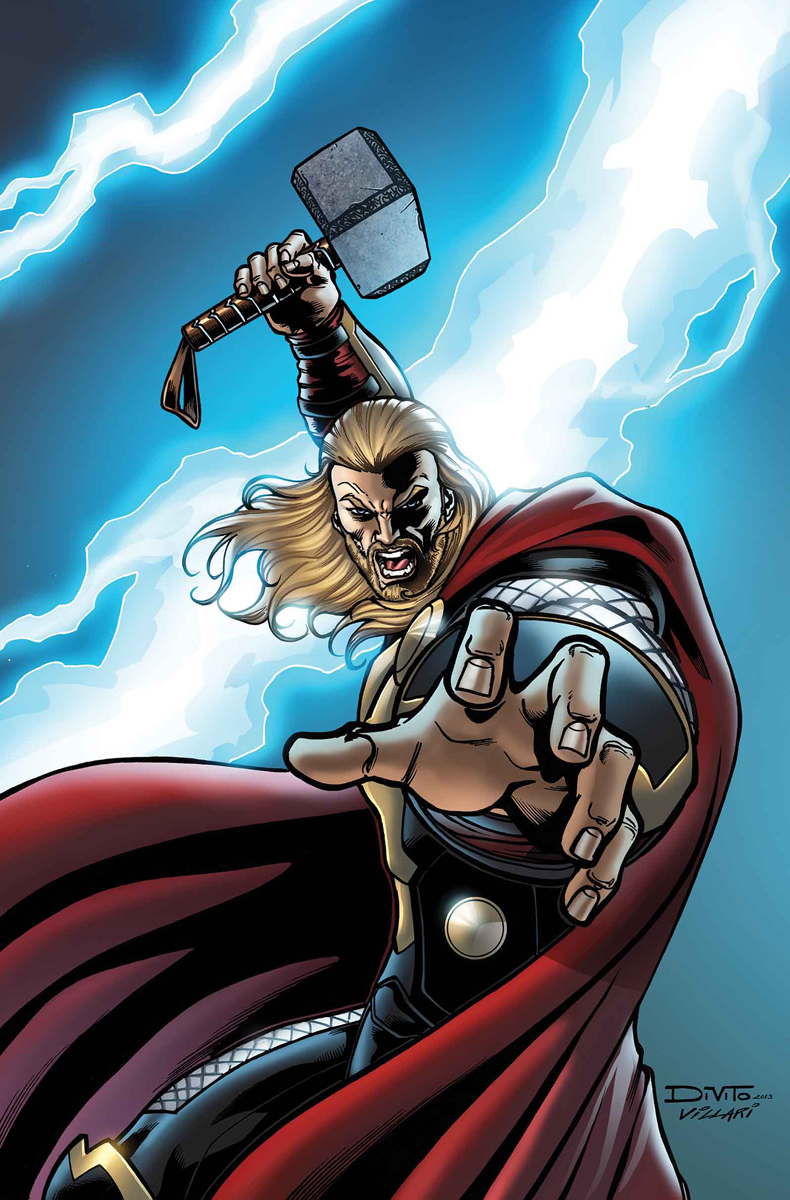
Thor in the recent "Crown of Fools"
© 2013 Marvel Entertainment
Having not particularly followed Thor, the biggest difference I see is that it looks like they've more-or-less done away with Don Blake.  I can understand that, I mean, it's fascinating enough on its own, but it was kind-of a cool idea in keeping with the notion that these meek guys could secretly be superheroes.


Thor: the Dark World wasn't quite the hit that Iron Man 3 or Man of Steel was, but it's keeping the Marvel banner alive and it proves that they can open a November film and it can do okay.


X-Men

X-Men #1
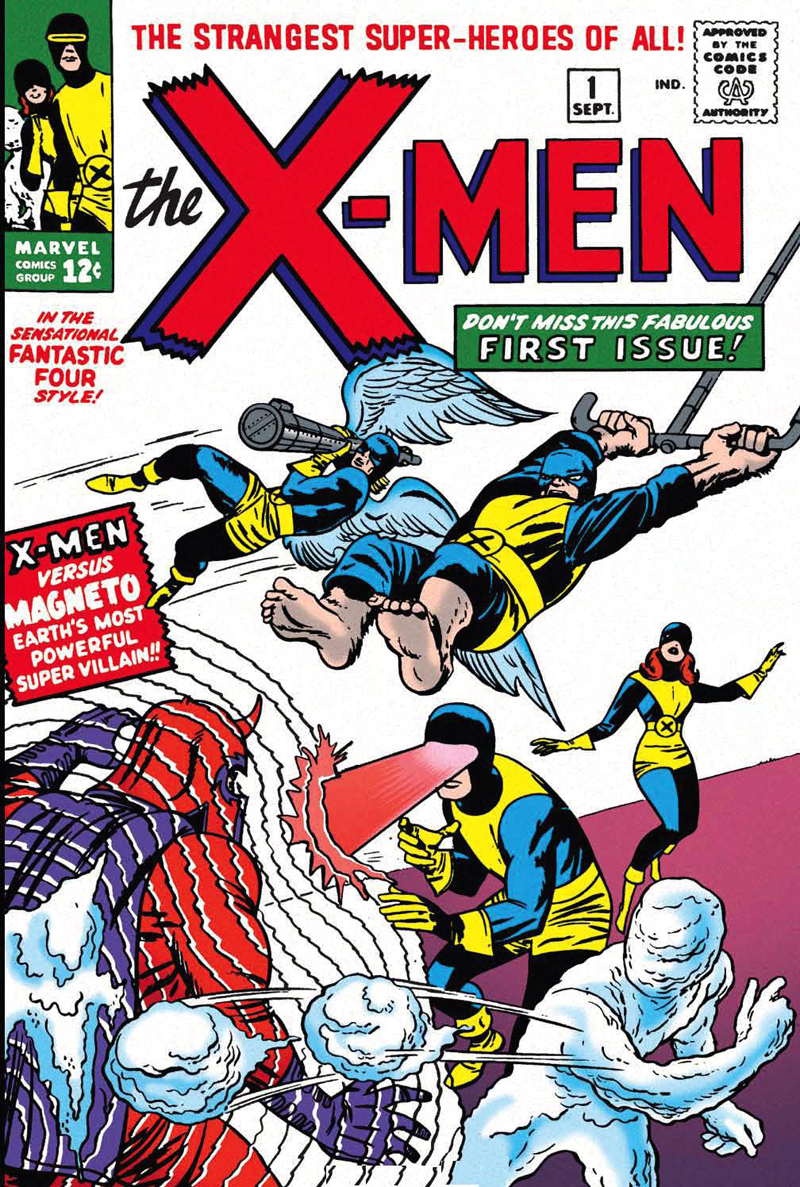
© 1963 Marvel Entertainment
Now, for the third comic on this list drawn by Jack Kirby and the second one written by Stan Lee.

I was actually going to do Wolverine's first appearance in The Incredible Hulk #181 (yes, technically, his first appearance was in #180, but from what I understand it was one panel) but I had a Hell of a time trying to find a reprint of it and when I was talking about it at my local comic book store, the guy said the owner had unloaded it for $2,000 so it's a bit out of my price range.  I had also wanted to do a "firsts" installment on various original teams (original as opposed to the Justice League or the Avengers where they were comprised of existing heroes) and the X-Men may be the most popular of all.

But seeing as how I have the first issue of X-Men (later retitled The Uncanny X-Men) and it's their 50th anniversary, this is more timely.  Besides, during their big five-oh, Marvel saw fit to bring back the original five and proved that Cyclops, Marvel Girl, Iceman, Beast and Angel--as the teenagers they first appeared as--still rock and that's an important thing to remember as all-too-often, people still write them off as a poor man's Fantastic Four.

Before we begin, here's Wolverine's first appearance eleven years after the original team's introduction.

© 1974 Marvel Entertainment
There, that's it.  But while I've looked at The Incredible Hulk #181 in a collection and online (the first few pages of it anyway), I don't own a copy and can't find one, but since these two panels comrpise his first appearance as far as I know, there is the first dialogue spoken by him and the first illustration of him.  Cat-like mask but otherwise the same costume as he had in the late '70s and the '90s.  And yes, he's got an attitude and his trademark claws.  That's all the information we get, and from what I've seen in my Marvel Masterworks: the Uncanny X-Men, that's all we see for a while.

But we're not talking about him today.

Nope, the story starts out with a training session between the four male members of the X-Men.  Of course the name X-Men implies that they're all male, but in this issue, we also meet one of the greatest super heroines of all time.  She's given a code name, Marvel Girl, but by the '90s, she was better known by her given name: Jean Grey.

Interestingly, many introductory installments of the X-Men focus on a female member joining the team, whether it's Jean in this issue, Kitty in Pryde of the X-Men, Jubilee in the first episode of the classic '90s series, Rogue in the first movie, or Magma in the first X-Men: Legends game.

One of the most interesting things fans have noticed about the early X-Men is that Beast is played as something of a "palooka" (in the words of podcaster Michael Bailey) which was common for the super-strong Marvel heroes.  First, there was the Thing from Fantastic Four, then the Hulk.  Within a few issues, however, Stan seemed to want to bring the character in a different direction.  After-all, why does the strong guy have to be the brute as well?  Why not a super-strong character who's also intelligent and studious?

From left: Beast, Iceman, Cyclops, Marvel Girl and Angel
© 2013 Marvel Entertainment
The rest of the characters' personalities mirror the Fantastic Four as well.  Iceman is the young guy like the Human Torch, though trading in the James Dean attitude for more of a prankster motive.  Jean Grey was the beautiful and intelligent but naïve young woman that Invisible Girl was and Cyclops was a stone-faced leader in the vain of Mr. Fantastic, though without the scientific acumen and a way cooler power, and yet, the Angel was a bit of an aristocrat and fairly arrogant, so I guess that would make him the Sub-Marriner, given that the next few issues would have a bit of a love-triangle between the three of them.

After we're introduced to our teen heroes, we transition over to Magneto, who is busy taking over a military base.  Like I said, Jean Grey may be the greatest super heroine of all time, and similarly, Magneto may be the greatest super villain of all time.  Not only does he have the power to manipulate the magnetic field and all objects made of metal (a particularly lethal power when Wolverine and Colossus joined the team) but the way he saw himself as the true hero, at first simply hating humans and wanting to exterminate them.  As the series rolled on, the idea that the X-Men were feared and hated by normal humans became a major theme, and Magneto's role was that of a sort-of radical who wanted his people--the mutants--to take over the world after being oppressed.

© 1963 Marvel Entertainment
Back at the X-Mansion, Jean puts on her costume while the other X-Men sneak in and ogle her, except for Cyclops, (her future husband as it turned out).  Then, they're interrupted by the news that Magneto is attacking a base, so they take a Rolls Royce to a secret hangar and board their own private jet to get to the base Magneto took over.

© 1963 Marvel Entertainment
Cyclops get knocked out blasting Magneto's force field but Magneto launches a bunch of missiles.  Angel draws their fire, but Iceman freezes some of them, while Beast grabs one with his feet and Marvel Girl uses her telekinesis to move one into the ocean.  Magneto tries one last-ditch attempt at destroying them by forcing a cart full of rocket fuel at them, but Ice Man covers them up with an ice shield and they force the villain to retreat.

The army is grateful to for their help, but that gratitude is eventually whisked away as the concept that normal people hate and fear mutants--the race to which the X-Men belong--and the series is used as a metaphor for battling racism.

So how have the X-Men changed over the years?  Well, at first, it just came down to adding the occasional new members and supporting characters, with even enemies turning into allies.  They were also sometimes rewarded with their own individually-designed costumes.  But then, the book was cancelled, although Marvel kept publishing it, using reprints of older stories.

So that was that, right?

Well, does this look familiar?

© 1975 Marvel Entertainment


How' bout this?


Or this?


Or this?

© 2002 Marvel Entertainment


Or this?


The X-Men have probably had more personal changes than any original team, and debatably more than even teams like the Justice League and the Avengers.  It's hard to even pick what the definitive team would be, but again, the most essential member doesn't seem to be one of the original five, it seems to be Wolverine.  He was the first to get his own series, and his own solo films.

Another mid-'70s addition to the team who's proven invaluable was Storm, who's possibly the most famous black superhero of all time, and rivals Wonder Woman as the most beloved superheroine.  In fact, she defeated Wonder Woman in the 1996 miniseries Marvel Vs D.C. which was, let's face it, a glorified popularity contest.  Not only that, but playing Storm seemed to move Halle Berry's career up a notch, even though her role in the first film was somewhat small and utilitarian.

Storm, Wolverine and Cyclops seemed, for a while, to form a "big three" for the team, the way Superman, Batman and Wonder Woman did for the Justice League or Captain America, Iron Man and Thor did for the Avengers: the team could go through any number of line-up changes, but the nucleus of the team being intact was so all-important that without them, it just didn't feel right, although after a while, that just stopped being the case.

Back to Cyclops and the other original five.  In 1982, Cyclops finally left the team after the other original four had quit years earlier (in fact, Jean died but it turned out to be a clone, while the real Jean was… you know, I honestly don't understand either).  The original X-Men returned, however, in 1986's X-Factor series, in brand new costumes.  This lasted a number of years, but the 1991 revamp of the team and ensuing towline, video games and animated series marked not only a growing interest among comic book readers, but an explosion of the characters in popular culture in general.  All of this before the 2000 film X-Men ushered in a new generation of superhero films.

© 1986 Marvel Entertainment


Days of Future Past, based extremely loosely on a pivotal two-parter from the 1980s, will hit theaters in 2014.  In this trailer, we can see Professor X, Magneto, Beast and I think Iceman are there, and Jean Grey appeared in this year's The Wolverine, but I don't think Cyclops is coming back.


Meanwhile, the original team has returned.  Starting this year, All-New X-Men saw the blue, furry Beast bringing the original team back from the past in an effort to talk some sense into Cyclops who had teamed with Magneto and become a militant mutant himself.  It backfired and as of this entry, the original team has joined the older Cyclops' faction.  How it plays out is anybody's guess because if there's one thing the X-Men aren't, it's predictable.

When it comes to the irreverence that makes
teen heroes so appealing, the original
X-Men still got it.
© 2013 Marvel Entertainment

Monday, December 9, 2013

Superman: the Films of Christopher Reeve

Yes, this is my fifth Superman-related blog, but I warned you that this blog is a Superman-centric one.

Christopher Reeve: whom many consider the definitive Superman.
© 1978 Warner Bros.

As an unabashed Superman fan, I've been very protective of Man of Steel, and a lot of the acerbic reaction to the film has come from fans--or people purporting to be fans--of the Christopher Reeve films.  That being the case, I wanted to look at the films of Christopher Reeve.  The good, the bad, the overrated, the underrated.  He may have indeed been the definitive Superman, but I also think that a certain cult of personality has developed around him (especially after his 1995 accident) but what's really important is the films themselves.

Now, I'm sorry that this writing had to start on a sour note, but that's what the character's fandom is becoming: sour.  There's always some rivalry attached to the character, and I think enough is enough.  Meanwhile, his popularity since these films ended has been like a weird EKG; and the almost barbarous division in the character's on fandom is much more disturbing than any attempt at "making him dark."

This is not going to be a bunch of reviews in the sense that I'm not recommending or not-recommending these films.  You won't see any star ratings here, nor will I direct a particular type to see these films.  They are that they are: the first one is required viewing.  The subsequent ones… not so much.  I'm also not going to talk about the 1984 Supergirl movie, or the 2006 quasi-sequel Superman Returns.  In all likelihood, you've already seen them if you're reading my blog, so this is more of a collection of my thoughts.

Superman: the Movie (1978)


As I've said before, this is one of the most pivotal moments in the character's history.  Not only did it say that you could make a blockbuster out of an old comic book or, well, anything else people might find silly or quaint.  In film history, there tends to be two of every movie, and I would compare this film to Paramount's Star Trek: the Motion Picture.  Both were highly-anticipated science-fiction films based on existing "franchises" (I hate that word but it works here) and to not be afraid to pump some money into what might have been a cheepie serial or TV series.

The story has become a template for the Hollywood of today.  The producers, Alexander & Ilya Salkind along with Pierre Spengler, went to Warner Bros. with a proposal to take the character they owned--Superman--and make a multi-million dollar production with an unknown in the main role surrounded by huge stars.  In fact, Marlon Brando's salary of an unprecedented $3.7 million was controversial at the time, and set what many would call a dangerous precedent.

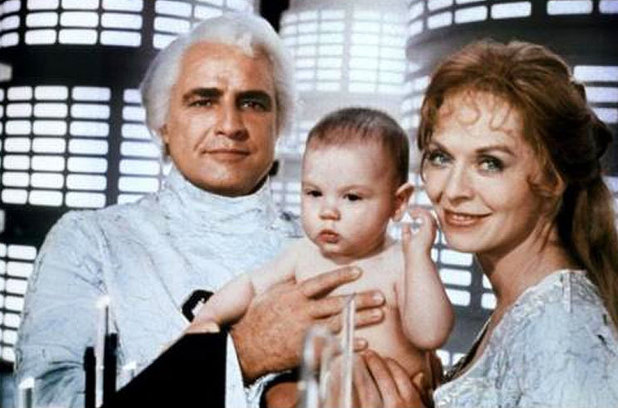
Marlon Brando & Suzannah York as Jor-El and Lara
© 1978 Warner Bros.

After a long, storied search for a director and star, the Salkinds hired Richard Donner, who had gained prominence for his film The Omen, and thanks to this film, would become one of the hottest directors in Hollywood.  Donner, in turn, went with his gut and rolled the dice on an unknown by the name of Christopher Reeve.

The film begins with the image of an old comic book and a little girl's voice saying, "in the decade the 1930s, even the city of Metropolis was not spared the ravages of the Great Depression," which strikes me as incredibly weird and corny.  It would make sense if the film took place in the '30s, or if they were playing up the idea that it's a comic book story; but it's just kind-of there.  It doesn't really serve the story or the atmosphere.

Speaking of atmosphere: this film has that in spades.  Once that bit of nonsense is over, we're treated to one of the greatest title sequences in history, as we cruise through space to John Williams' brilliant Superman march.  The lettering flies past us as we see all sorts of space phenomenon taking place.  It's an incredible flurry of sights and sounds, that ends on an establishing shot of Krypton.

This Krypton is quite different from what the comics had been.  Rather than a civilization with a bunch of advanced machinery and costumes right out of an old serial, we see an ice planet where "technology" comes in the form of what seems like magical crystals.  Brando's voice bellows, "this is no fantasy!" and we see him reigning over the trial of three criminals who had apparently attempted to overthrow the government.  Within the context of this film, this comes off as incredibly pointless, and it would have served the film better if it had been dealt with as more of a cliffhanger.  After-all, it is paid off in the second film.  But from a fan's perspective, it just comes off as an arbitrary change to make Jor-El a judge.  I mean, I'm not saying, "oh no, they changed it, now it sucks," but it is incredibly contrived.  Are people usually both judges and astrophysicists?  Is Jor-El just that much of a renaissance man?

Jor-El promises that neither he nor his wife will leave Krypton, but then, inevitably, he places his baby Kal-El into a small (oddly-shaped) rocketship and sends him to Earth.

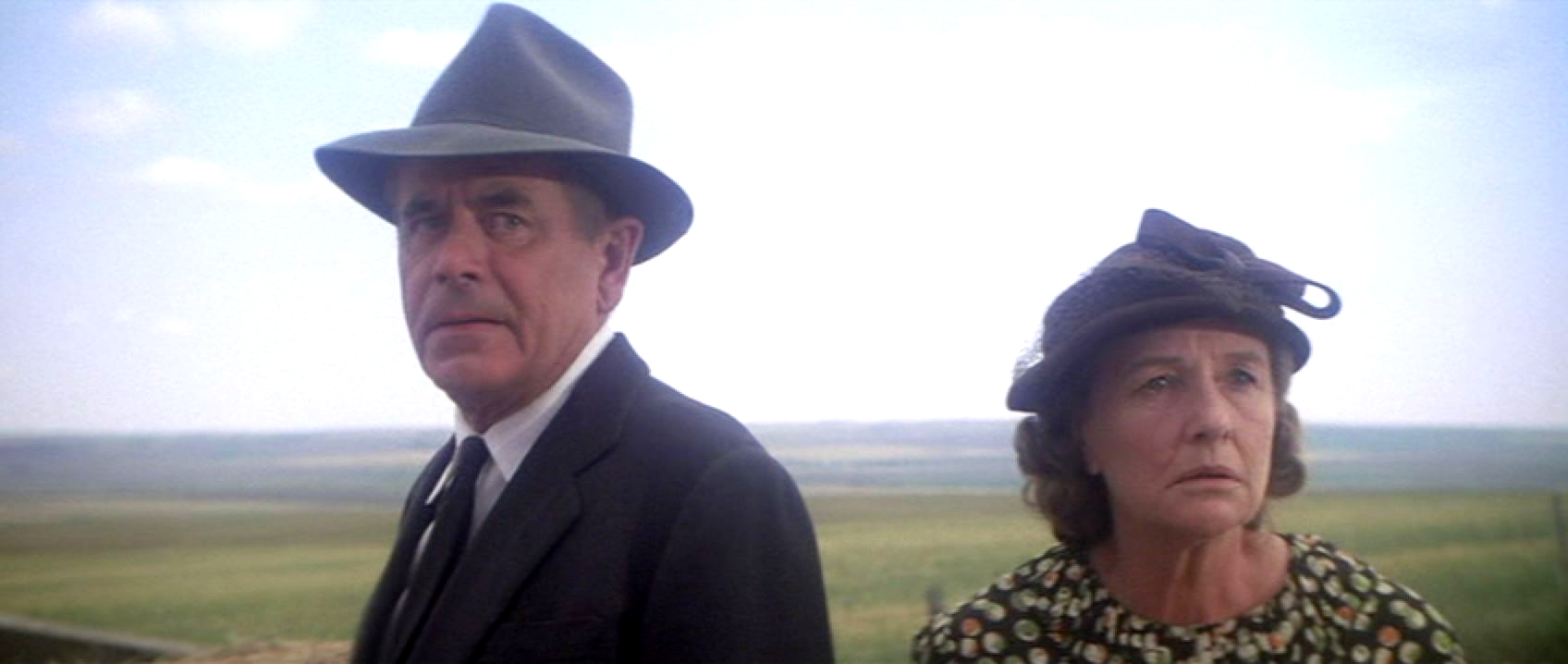
What follows is the heart and soul of the picture.  Glen Ford and Phyllis Thaxter are both incredible as Jonathan and Martha Kent, and I appreciate the fact that when they come to Clark's high school years, they make the bully--Brad--seem just mean enough to convey that he doesn't like Clark, without turning him into some kind of caricature.  Ford's death scene is quite moving, and it just sublimates the audience before the green crystal beckons him to the North Pole where he tosses it into the snow and creates the Fortress of Solitude.

© 1978 Warner Bros
Now, here is a real bone of contention among Superman fans.  When Clark arrives in the Fortress, a hologram of Jor-El begins talking to him, and we get a long summery scene of Jor-El teaching Clark how he must use his powers for good, to be "the light to show the way."  Basically, a formal calling.  Fans of comics since the 1986 reboot have felt that Superman's motivation should come from the way he was raised instead.  It also raises some eyebrows among fans to think that Clark just sits in the Fortress for twelve years, as seems to be the case.  I have a different take on it, that he'd simply returned to the Fortress every week over a 12-year period; otherwise, how else would he get his degree in journalism or communications, find an apartment, have any references, etc?
From left: Christopher Reeve, Margot Kidder and Jackie Cooper
© 1978

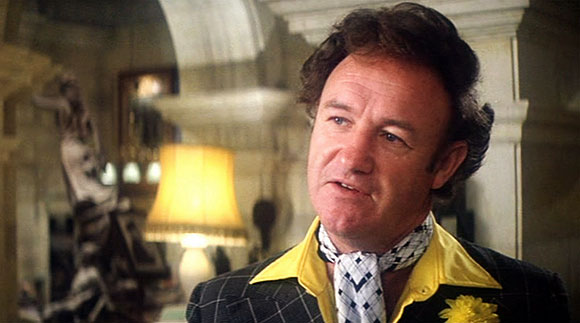
Gene Hackman as a very hammy, wig-boasting Lex Luthor
Not pictured: his bumbling sidekick Otis and busty moll
Miss Tessmacher.
© 1978 Warner Bros
Anyway, let's move on: Clark gets his job at the Daily Planet, and we meet Lois, Perry, Jimmy, etc. while we also learn about the nefarious Lex Luthor.  While the cast of the Daily Planet is great (yes, I thought Margot Kidder was a splendid Lois), Lex Luthor is played as a comedic villain with an even more comedic sidekick (Otis) and nothing like the evil mad scientist of the pre-Crisis comics.

This remains a very controversial choice for the film.  The movie was marketed as a step away from the Batman TV series of the '60s, and yet, Lex would be right at home on the series.  Why?  Well, my theory is that while they saw the value in a more serious, expensive superhero epic, there was still a market for that show, and they wanted something to meet those expectations.  Makes sense, but I don't know if it should have been the main villain.

Just as an aside: I actually think she looks pretty good here.
© 1978 Warner Bros
Also, something of a controversy was the degree to which the film focused on the love story.  The scene where Lois interviews Superman on her balcony (very posh quarters for a newspaper reporter) and the two go flying, while Lois recites a poem in her internal monologue.  This poem makes an already mushy scene downright overwrought.  If you decide to rent this film, this is the part where you get some more popcorn or another Coke.

Now, once Lex manages to get Superman's attention and he goes after the missiles, the film picks up again.  It feels like an action film.  Not in the sense that most superhero films are--with a major battle between hero and villain--but more like Top Gun or Backdraft where something else drives the action.

Like many special effects film, the effects start to get more sloppy toward the end.  This is true even today.  Nevertheless, there are a lot of great special effects shots and Reeve sells it with his earnest performance.

Finally, there's the ever-controversial ending, which I criticize on the grounds that the film never set up the fact that Superman could travel through time.  True, Marlon Brando did use the phrase, "it is forbidden for you to interfere with human history," but that could mean any number of things.  I do want to address a certain misconception: that Superman turns the Earth backward to travel through time.  Actually, he's just spinning and in one insert shot, you can clearly see his fists balled, rather than actually pushing the Earth back, and the reason the Earth rotates backwards is because the film is simply following Superman through time.

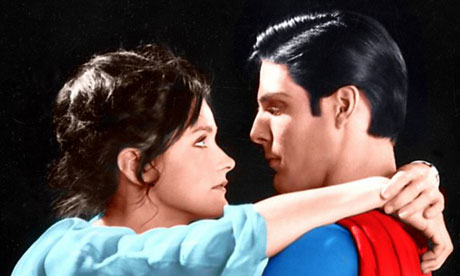
Christopher Reeve as Superman in the exciting climax.
© 1978 Warner Bros
Superman was the second biggest film of 1978, falling behind Grease by $50 million or so.  This would be the highest rank of any Superman film in a given year, and so far, no Superman movie has been the biggest film of the year.

The film was part of a movement.  Along with Star Wars, Alien, and Star Trek: the Motion Picture, Superman presented a film whose subject matter may have, at one point, been relegated to a cheap b-movie.  These films were larger than life, ambitious and they got people talking.  To studios, the most important thing was that they were highly profitable and it was easy to market merchandise: something at which Superman lent himself all too well during the dawn of the eighties.

Oddly, the film's imitators did not come in the form of other superhero films.  Yes, there was a Supergirl movie, and if you count Swamp Thing as a superhero, he had one; but D.C.'s major stable had a long way to wait.  A Batman film was in its early stages, but would not see the light of day until the summer of 1989.  Meanwhile, at Marvel, their heroes had mixed results, with The Incredible Hulk being the biggest success on that front.

Finally, the film brought Superman himself back.  While the comics had the occasional milestone for the character, the industry as a whole was in a slump, and D.C. was far behind Marvel in terms of sales.  Meanwhile, the T.V. series was still airing in reruns, but it was surely showing its age, while in animation, gone were the mighty Fleisher cartoons, and in their place was the über-cheesy Super Friends.

Richard Donner's 1978 masterpiece brought the character back into the limelight.  It put Superman on everyone's minds and proved that films could make you believe a man could fly.  In a few short years, a sequel continued this trend, and cemented Superman's place as an early-'80s action hero.

I just wish I could understand why.

Superman II (1980)


Oh, that I could say that this was a great film.  After-all, it was the first superhero film to showcase a gigantic battle as its climax and the first superhero blockbuster sequel, being the #3 film of 1981*.  A taproot to films such as Batman ReturnsX2Spider-Man 2 and The Dark Knight and a contemporary of great sequels like The Empire Strikes Back and Wrath of Kahn.  Unfortunately, this film really, really... blows.


I know that's harsh, but what do you want me to say?  The film just isn't very good, and the reason lies in the fact that it was initially filmed along with the first movie, with Richard Donner at the helm.  When the film was about 80% finished, cooler heads prevailed and the production turned its focus to the first movie so it could be completed by Christmas of '78.  When the first film was released, it was an enormous hit, but Donner was fired from the film after mouthing off about the producers with whom he had a fractious relationship.

Enter Richard Lester, who was best known for the Beatles films A Hard Day's Night and Help! Lester, obviously, had a much different style from Donner and was required to reshoot much of the ground Donner had covered (or come up with new scenes) and by the time the film was finished, what resulted was a patchy film without the sense of rhythm and color of the first movie, and with some of the biggest plot holes ever to be seen in a major film.  Mind you: this movie wasn't some old serial, but a film that stood its ground against the summer '81 onslaught of Raiders of the Lost Ark.

The film starts with a recap of the first movie.  This is one of those things that sequels do sometimes, and it may have seemed more necessary at this point, but future Superman films eschew this convention.  When the film catches up with us, we find Clark Kent going to work on a typical day only to find out that Lois has been taken hostage by terrorists at the Eiffel Tower.  He then heads to the back ally, changes into his costume with an incredibly cheesy effect, and flies off to Paris.

© 1980 Warner Bros.
Superman grabs the bomb the terrorists planet and throws it into space, and the blast happens to hit the glass floaty thing in which Zod, et. al. are held prisoner.  After they find themselves on the moon, they learn they have great powers and fly off to Earth for more mischief.

Meanwhile, Lex Luthor escapes from prison in a comical fashion, leaving Otis behind, and takes a hot air balloon (!?!?!?!) to the Fortress of Solitude.  I should point out that the "fortress" in this film is hardly a "fortress," and more of an icy palace with crystals, so Lex and Miss Tessmacher simply waltz in.

While Lex is busy learning about life on Krypton, Lois and Clark are assigned to an investigation into hotel fraud and pose as newlyweds.  Lame.  Lois becomes more and more aggressive about trying to prove that Clark and Superman are one-and-the-same and after he saves a boy from falling into Niagara Falls, attempts a similar stunt to draw him out.  He instead uses his heat vision to burn a branch off of a tree for her to grab onto and saves her without drawing suspicion to himself.

Now, in spite of the cheese factor, so far all of this has the makings of a good Superman film.  A larger than life threat while there's drama in the love triangle.  What follows is, perhaps, one of the stupidest hours of Superman's history and of blockbuster cinema.

© 1980 Warner Bros.
When Lois and Clark return to the hotel, Clark burns his hand in a fire.  Except he doesn't burn his hand, because, well, he's Superman.  And so seeing this, Lois discovers the truth, and the two of them fly to the Fortress of Solitude for a candlelight dinner.  Yup: he's just blown the secret of a lifetime and she's just discovered that the man of her dreams has been lying to her.  Nothing like a nice bottle of white zinfandel to celebrate the occasion.

Unfortunately, even as unbeknownst to Superman, General Zod and the others are attacking a small town, Superman consults the crystal of his late mother Lara to ask for her blessing in this relationship he's been in for about a half an hour.  She says that he must choose between his powers and a relationship with Lois.  Now, here's where I'm gonna toss the snark on the floor and just go for indignation: the fact that he just hunches his shoulders after a moment's thought and says, "I lover her," then proceeds to give up his powers in the molecule chamber is a complete insult to my intelligence.  Even if we're to accept the premise that he must give up his powers to be with her (and this was about a decade before they were engaged in the comics, though the Superman of Earth-2 had been married to Lois for quite some time) the fact that he does it so impulsively and, as one writer said, casually is just idiotic!

The three villains from Krypton are the best thing about Superman II.
© 1980 Warner Bros.

Oh, and did I mention that Lara says, repeatedly, that if he goes into the molecule chamber, he can never get his powers back?  Well, she does.  NEVER!!!  Not, "until you change your mind," but never!  This, of course, takes place while General Zod takes over the White House as Superman and Lois play house.

Now, if you can believe it, the film gets even dumber.  Even though the Fortress of Solitude is supposed to be somewhere in the North Pole, Clark and Lois are able to drive to a diner located in, I don't know, let's say Canada.  It's still beyond a stretch, but no way they got all the way to the U.S.  Clark gets his ass kicked by a local bully in typical "he sucks without his powers," style, and he learns what audiences already knew: that General Zod had basically taken over the world.

At around this point, Luthor lets General Zod know that Superman is still a force to be reckoned with and that they might know his old man, Jor-El. As the three villains thrill to the notion of killing the son of their jailor, Superman trudges back to the Fortress on foot.  Yes, he's actually able to get there on foot without his powers, and here's where the film goes from lousy to inexcusable.

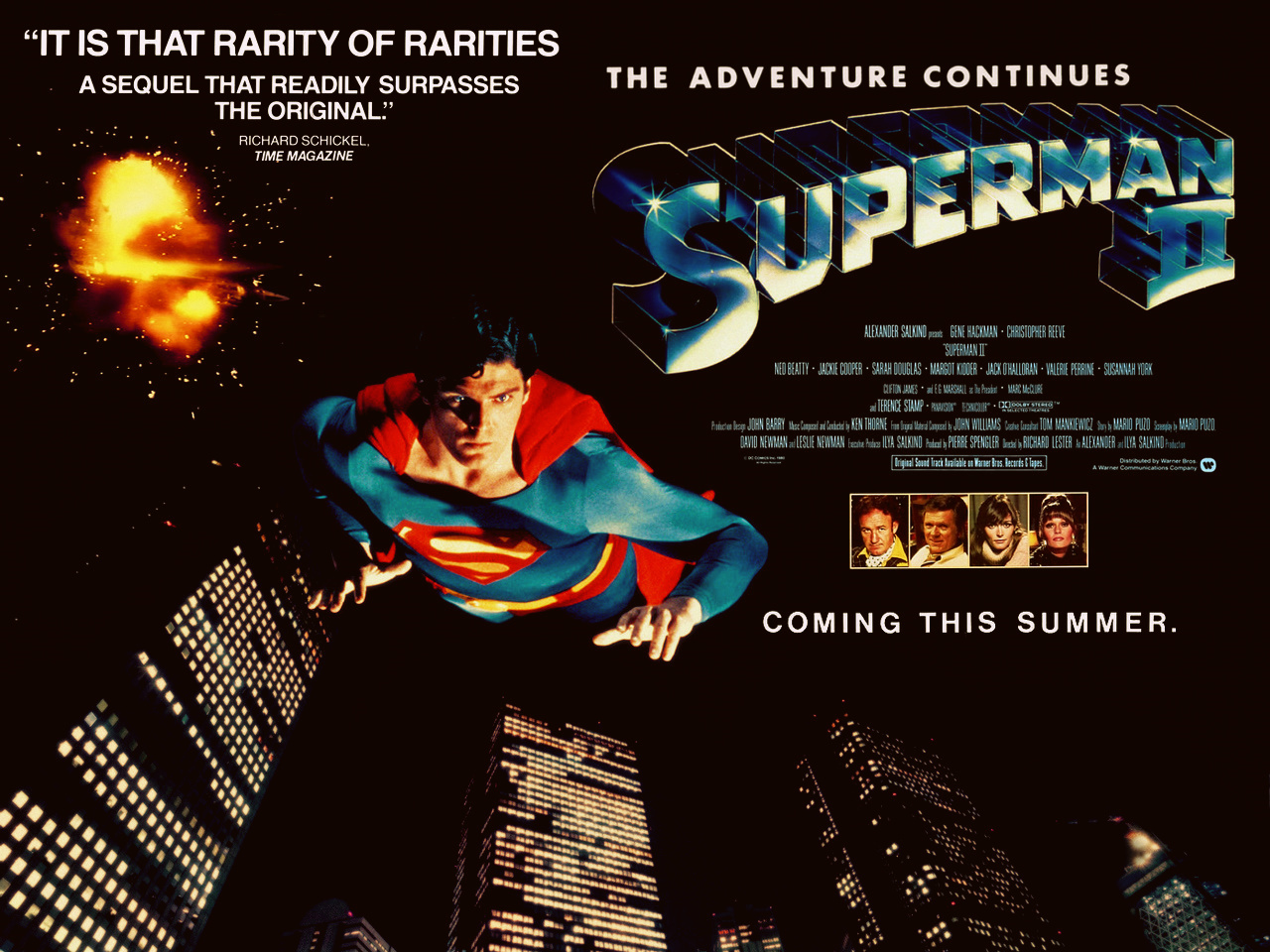
I'm just putting this poster here, cuz it's cool.
© 1980 Warner Bros.
There's no explanation for how he got his powers back.

Now, some people will say, "oh no, there's one of those green crystals lying in the ice," but come on!  That doesn't tell us anything except, "it has something to do with the magic crystal stuff this film thrust upon the mythos.  How does he get his powers back?  Especially since Lara said he "never" could.  Now, to bring up the 2006 Richard Donner cut of the film, yes, there's a scene in which Jor-El tells our hero that he has fulfilled some prophecy and that in this moment, he gets his abilities back.  Okay, so they graduated from a plot-hole to a cop-out; but the film still lies to us saying he can't get them back.  Regardless, we're not talking about the Donner cut, we're talking about plain old vanilla Superman II and we don't even get that.

Podcaster and Facebook friend Trentus Magnus put it best, I think, when he said that this film and its predecessor are full of moments that, if they were in Smallville or Man of Steel would be crucified by fans and critics alike (I can't remember how he phrased it, but check out his podcast Trentus Magnus Punches Reality) and this is the perfect example.  How can they possibly justify this lapse in narrative common sense?

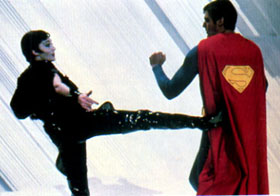
So yeah, he gets his powers back, flies to Metropolis and confronts Zod n' co. who want revenge on him because, you know, his father sent them to the Phantom Zone.  What follows is a sequence that I frankly don't know how to judge.  I still feel it lacks a certain sense of urgency that a good fight scene should have.  Even the '50s TV show had fights that were at-least well-choreographed, and while they aren't exactly blood-pumping, some of them hold up okay because there's more energy.

A still from the action-packed climax of Superman II.
© 1980 Warner Bros. Entertainment
And yet, it's still an ambitious undertaking for its time, so it deserves credit for that.  It doesn't save the movie for me, but it's still interesting if nothing else, even if it doesn't dazzle at this point.  I'm not even going to get into little qualms I have with the fight itself, except to say that the citizens of Metropolis are friggin' idiots.  They act like they're putting on a light show with lines like, "this is gonna be good," "*gasp* the big one's just as strong as Superman," and, "man, Superman didn't even do nothin'!"

Now, as usual, I'm about to give away the ending, but I'd like to reassert that I'm giving an analysis of these films, not just a review.  I've said above that this isn't about reccomending these films, and I'm assuming that my notes will have little impact on whether or not you see the movies in question, so here comes my description of the ending.

Superman flies of mid-battle in what he hopes looks like a retreat, but is really a gambit to lure them back to the Fortress of Solitude.  Let's give them some credit for this, I mean, he is using his head instead of just knocking them out; but still: what if his plan hadn't worked?  Would he really just let everybody in Metropolis suffer the wrath of Zod?

© 1980 Warner Bros.
Well, in any case, they fly into the Fortress of Solitude, which by the way, looks incredibly fake.  Yeah, I know they had to reshoot a lot of it and that meant rebuilding sets that weren't meant to stand, but I just wanted to let that be known.  Anyway, Superman has some gizmo set up where he creates holograms of himself and fools around with the bad guys before they take Lois hostage.  Because the villains also want to kill Lex, Superman confides in him that he wants to lure the villains into the molecule chamber which had taken his powers earlier.

But, oh, our hero doesn't go down that easily.  See, he somehow managed to make it so that the molecules are switched throughout the fortress and thus robs the villains of their powers while he's safely inside the chamber.  He crushes Zod's hand and tosses him into a deep, yawning chasm in the Fortress.  Non follows and Lois punches Ursa down into the pit and the two romantic leads plus the comical villain of Lex head back to Metropolis.

Um...
© 1980 Warner Bros.
If they survived, there's no indication.  It looks like Superman killed the three evildoers.  Oh, I've heard some excuses for this, particularly in pointing to a deleted scene on the Richard Donner Cut of the film wherein the villains are taken in by the Arctic Police.  One day, I'll air my grievances with that version of the film, but regardless: it doesn't count.  Not only is it a deleted scene, but it's a deleted scene only available on the original director's cut of what the film was supposed to be.

What happens next is the cherry on the ridiculous sundae.  Lois and Clark have a heart-to-heart about how tragic it is that the two of them must be apart.  You know, because now he has his powers back and his mother's holographic ghost basically just ordered him not to date anyone unless he gives them up.  So what does our hero do?  He kisses her, which makes her forget about everything since the beginning of the movie.

Yes, folks: another power that Superman exhibited by-and-by in the comics, but he never used throughout the exposition phase of the movie, so it's just a deus-ex-machina.  But hey: that's what these movies are all about by this point.  Superman's enemies exhibit powers unseen in the previous films and, really, in the comics.  There's also what I believe to be gadgetry in the Fortress of Solitude, including a holograph device (though one hologram is made of stone or something) and a giant cellophane \S/ that is apparently sturdy enough to take down Non: the biggest of the three villains.

What's more: don't you think that he and Lois should sort out their little problem like adults?  Now, it may break Lois' heart that she'll never be with the man she loves (because a hologram of his dead mother said she couldn't) but people have their hearts broken all the time in real-life.  They can't just see where things go?  Plus, they had a sexual encounter (you know, because Superman's the big admirable boy scout, so he bangs Lois after being "with" her for, like, three hours) and making her forget that has unfortunate implications highlighted in Superman Returns.  One day I'll skewer that film.

Again: I want to like this film.  I want this to be a film I can watch over and over again.  I want to say that it's an exciting, well-written film that paved the way for the kinds of superhero sequels I mentioned.  I want this to be the film I can show people who think the character's just this boring non-entity.  But I just can't!

The biggest problem is that the film has one colossal flaw--the plot hole of how they never show him getting his powers back--but it also has a myriad of little problems, as well as overall flaws like the lackluster style, the tedious pacing and the over reliance on gags--something we can thank both Donner and Lester for.

Superman II falls more in the category of sequels like License to Kill where critical response seems to come more from the idea of moving the series into a new direction rather than the real execution of the piece.

© 1980 Warner Bros.
Finally, one word people like to use to decry Man of Steel, along with Smallville and Superman Returns is "emo."  This is an extremely lame buzzword, but if it has any meaning, it's embodied just as much in Superman II as those films.  It all revolves around this love-triangle caused by the irrational, overly emotional decisions of a young man who, had he been acting smarter, would not be in the state of misery he often seems to be.

Superman III (1983)


This is my "guilty pleasure" Superman movie.  Where Superman II is hailed in some circles as a great film, this film is almost universally derided, and yet, I enjoy it.  Yeah, that's right: I like it, despite being overly comedic and having villains that make Hackman's Luthor look downright awesome.  I'm not saying anyone else who sees it will enjoy it.  I'm just saying I do.


Now, you may wonder how I can defend the Superman film that's flat-out comedy when I deride the humor in the first two films.  Well, my response is basically that in those films, it just doesn't fit.  With Superman III, we start with a slapstick number, and you either like it or you don't, but it sets the tone for the rest of the picture.  The nine-year-old me laughed, and I never really had a reason to stop laughing.

It seemed moviegoers did, however.  The film placed at #12 of the year.  The same slot a certain Batman film with similar problems would inhabit fourteen years later.  And really, the film had a lot of competition.  Previous Superman films had avoided direct competition with Star Wars films, but this time, it was released in the same summer as Return of the Jedi which was the year's biggest film.  There was also the 007 war with Octopussy, the thirteenth official James Bond film paired off against Never Say Never Again, an independently-produced James Bond film (which Warners distributed) that brought Sean Connery back to the role.  Add in favorites like Terms of Endearment, FlashdanceWar Games, Risky Business and Mr. Mom and Superman III just had too much competition to overcome.  Still, the film did manage to beat the later Bond picture, as well as Jaws 3-D and respected films like Scarface and Silkwood.

For some stupid reason, they started doing caricature paintings for the posters.
Never good, especially for eighties films.
© 1983, 2001 Warner Bros.


So what's the story?

Well, we meet a down-on-his-luck huckster named Guss Goorman, played by Richard Pryor.  Goorman comes to work for billionare Ross Webster and discovers that there are a lot of fractions of cents floating around that have never been claimed by either the employees or the companies.  Goorman "steals" them, and Webster finds out.  Because Goorman doesn't want to go to prison, he agrees to hack into the Vulcan satellite and cause weather problems in Columbia.

Meanwhile, Clark pitches a story about returning to Smallville after becoming a big-time newsman.  En route to Smallville, he stops a fire at a chemical plant which was threatening to engulf some acid that, when it becomes hot enough, will eat through anything at all.

Once Clark gets to Smallville, we get reunited with Lana at the high school reunion.  Now, one thing that's awesome about this is that they're playing the Beatles' version of "Roll Over Beethoven."  Growing up, my two passions were Superman and the Beatles, so the marriage of the two things is stellar.  As well, Annette O'Toole is perfect as the kinder, gentler alternative to Lois.  As most hardcore fans know, she later played Martha Kent on the TV series Smallville and has come out saying that she did grow up reading the comic books.  It's also important to note that in this film, Lana is a recently-divorced single mother of an athletically-challenged boy named Ricky.  While this is an invention of the film, I think Ricky did carry over into the comics for a brief period.

EVIL SUPERMAN!!!
© 1983 Warner Bros.
Being in Smallville doesn't prevent Superman from foiling Goorman and Webster's evil deed in Columbia, so Webster has a brilliant plan: create a chunk of kryptonite to kill Superman.  Goorman attempts this, but because there's an unknown element in the samples being examined in space.  Goorman guesses that the missing element is tar, so he fills in that blank for himself, and creates a chunk of fake Kryptonite.

Posing as a grateful army general, Goorman hands Superman the chunk of kryptonite and it doesn't seem to have any effect.  We learn, however, that it has effected Superman mentally and he starts to turn evil.

Now… saying that Superman turns evil is a bit of a misnomer.  Actually, he just turns into kind-of an asshole, at-least until he's seduced by Webster's girlfriend into destroying a sea vessel for its oil content, after-which he has his way with her.

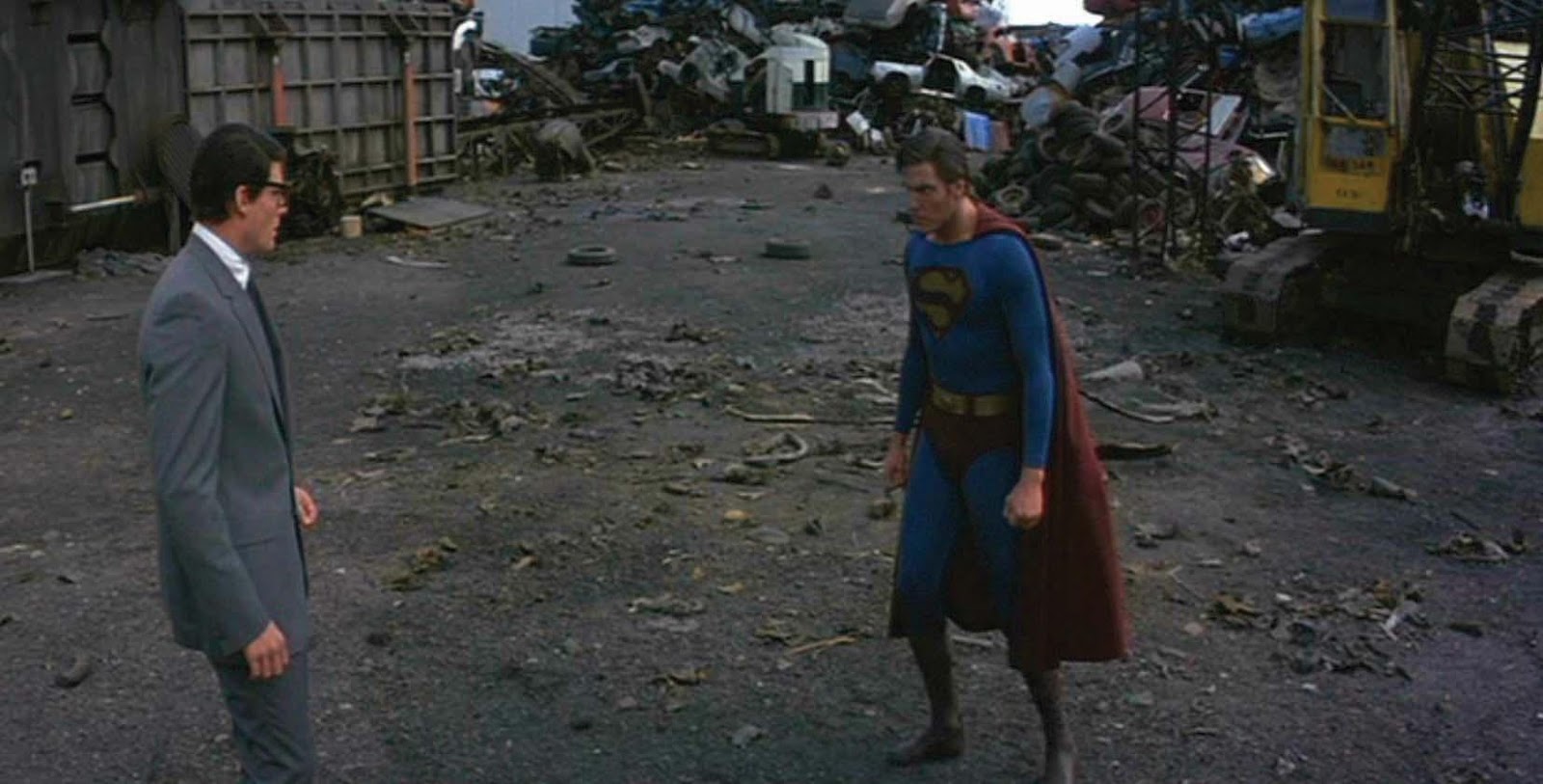
How does this all come to an end?  Well, in keeping with the tradition of random bullshit, Superman eventually just splits in two.  The "good" Superman is embodied in the form of Clark Kent, which has some interesting implications.  Anyway, there's a classic fight scene in a junkyard while it doesn't have the scope of the Times Square battle Superman II boasts, it's still well-done for the time and a classic "hero vs himself" fight.

Superman Vs Superman
© 1983 Warner Bros.
Now, as you will most likely predict, "Good Clark" wins and removes his suit and reveals the good old Superman costume; and as you can probably guess, Superman is now ready to take care of business and put the hurt on the evildoers.

The climax of the film takes place in the secret lair of the evildoers with Goorman's giant computer.  Superman flies into it and they launch missiles at him.  This makes for a pretty good action scene, but what's weird is that Webster controls the missiles using a video game, which is cool, but some people seem to think the game actually exists.

Whatever, he and battles the computer, and Webster's sister turns into a cyborg.  Yeah.  I'm gonna give away the ending that while the computer can anticipate any attack and create an appropriate counter-attack, Superman grabs some of the acid from the chemical plant, and the computer registers it as harmless.  Superman pours it on, then ignites it with his heat vision, which destroys the computer.

The film has some clever moments, such as the part where Superman freezes a lake and carries it over to the chemical plant fire, and when Ricky is bowling and Clark fakes a sneeze to propel Ricky's ball to get a strike.  It's just kind-of sad that the film gave us such underwhelming villains (though they were cast pretty well with Robert Vaughn's character being a decent stand-in for Lex) and to go into a comedic direction.

It's also interesting to note that the film kind-of turns its back on the idea that the hero can't have a love-interest as long as he has his powers, as Lana falls in love with Clark, whose a bit more of a developed character this time.  I also liked Paul Keathler as Ricky, as saccharine as he may be.

The previous year's Blade Runner and subsequent year's The Terminator cemented a darker and edgier route for action-oriented science fiction even if they weren't among the top films of their respective years of release.  1984's Ghostbusters and 1985's Back to the Future proved that there was a place for Superman III's blend of humor and sublimation in sci-fi/fantasy film; as long as they had intelligent and heartfelt scripts to back it up.

While Superman IV would eschew the comedy of III, it tried for more of a thinking man's quality… and failed miserably.

Superman IV: the Quest for Peace (1987)


I'm gonna take a different approach with this one.  Superman IV: the Quest for Peace has been absolutely ravaged for over a quarter-century because, as its star Jon Cryer once said to an interviewer, "they did not finish it."  The special effects are lackluster at best, the film is filled with plot holes and even the opening credits scream "cheapo."  Here… just watch.


The little "Superman IV" on the bottom doesn't help either.  In the '80s, that was something of a sign of a crappy production, and this film was produced by Canon films.  Why was it produced by Canon films?  Well, as discussed, Warner Bros. had actually licensed the films out to the Salkinds and their partner Spengler, and after the disappointing Superman III and the flop Supergirl, he decided to let this company--known for low-budget, forgettable films--roll the dice.

Obviously this is a recipe for disaster, but what could have worked--albiet, in a preachy, anvilicious way--was the idea of Superman taking on the issue of nuclear weapons.

Nuclear Man
© 1987 Warner Bros.
Imagine what could have been if Warner Bros had produced the film themselves, hired a bigger action director (and no, I'm not bashing Sidney J. Furie) and spent the $40-million they had given to Canon (which they seem to have basically embezzled) using Reeve's concept as a basis, and spent another year on the project to release it in time for the character's 50th anniversary.

There's still an argument to be made that it wouldn't have been enough.  In the years between 1984 and 1987, there had been a lot of changes in the action film market and the sci-fi/fantasy market.

The film starts with Superman rescuing a Soviet space crew after something goes wrong.  Right away we can see how lackluster the flying sequences are.  It's an interesting commentary on improving American/Soviet relations in the late 1980s.

We then catch up to Clark Kent on the farm.  After some business with a green crystal and information that the energy from Krypton will soon be depleted or something, in one of the film's more touching scenes, we see that Clark refuses to sell the farm to a developer who has known him all his life, and laughs about how Jonathan Kent "joked" that Clark must have destroyed his bassinet after a bad dream.

Clark heads back to Metropolis and has to stop a commuter train after the driver has passed out.  Interestingly, he seems to be stopping it with telekinesis, as if the filmmakers were trying to give Superman an arc involving the  power Zod demonstrated in Superman II which isn't one of Superman's standard ability.  While I prefer Superman stay at the typical power level (strength, speed, flight, the vision powers, even super breath), it is interesting that they're trying to build on this.

Now, of course Lex Luthor has been in prison since the events of Superman II and we find the evil genius cracking rocks, when his nephew Lenny shows up in this car that… eh, I'll spare you the details, he breaks Lex out of prison.


Lenny is another comic relief character like Otis.  As with many attempts to modernize something, it ends up being more dated, but it's cool since he's Jon Cryer.

They steal a strand of Superman's hair from a museum, because they wish to clone him and here's another lapse in logic that doesn't really bother me, but should: if the strand is so strong that it's able to hold a weight like we see there, then why are Luthor & nephew able to cut it?

Okay, who cares?  Anyway, the Daily Planet's been bought by a corporate asshole with a hot daughter who falls for Clark.  Her name is Lacy Warfield, and she's played by Mariel Hemmingway from Woody Allen's Manhattan.  She actually kind-of mirrors a character from the comics named Kat Grant in that they both fall for Clark and think Superman is kind-of just an overrated big boy scout.  Incidentally, Lana Lang is nowhere to be seen in this movie.

So then, a little kid writes a letter to Superman asking him to rid the world of nuclear weapons.  After a cheap stunt by the new Planet which is under the control of the slimy corporate Warfield guy, Superman reassures the world that he plans to get rid of nuclear weapons.

Jeremy spoke in class today.
© 1987 Warner Bros.
What better time for Lex to get in on the arms deal, right?  Well, the thing is not only does he begin trading arms, but he takes the hair he collected along with some other stuff and attaches it to a rocket that shoots into space.  And yes, people, he mentions an expanding piece of fabric to "maintain the high moral standard," meaning the film actually does explain how come Nuclear Man has clothes when he's first created.  At this point, I'm not asking for an explanation that makes sense, just one that exists and this film does it.

They unleash Nuclear Man on Superman while he's attempting a double-date with Lois and Lacy as both Clark and Superman.  It's a decent attempt at a comedy sequence, but even the writer has dismissed it as not being fast-paced enough, so be it.  The fights between Superman and Nuclear Man could be awesome, but they're badly choreographed, though it is nice to see the bad guy win a round as Nuclear Man's attacks leave Superman rapidly aging and his cape falls off.

After another "it has something to do with the crystal" moment, Superman's back in action and somehow divines that Nuclear Man wants to kidnap Lacy which… yeah, another one of those things where the explanation was left on the cutting room floor.

No comment.
© 1987 Warner Bros.
They have a battle which takes the two all the way around the globe to China where Superman repairs the Great Wall with his… um… fix-o-vision.  Yeah, then it's off to the moon and there's one shot where you can even see the wires if you look closely enough.

To those of you who claim Superman can expand his powers to people
he touches.  Yeah, whatever, kinda but not really, and even if the film's
continuity had that contrivance, they should have set it up at some point before the climax
© 1987 Warner Bros.
Eventually, Superman kills Nuclear Man by tossing him into a power plant, proving yet again, that people who admire this Superman because he never kills are full of shit.

Anyway, there are a lot of potholes in the end of the film, some of which are explained by the deleted scenes on the DVD, but again, those are deleted scenes and don't mean shit.  While I can give the creators a break in-and-of themselves, this movie is still an incoherent mess.  I actually do sometimes watch it just for the sake of having something on, but make no mistake: it's not a good film.

The movie did very poorly at the box office.  While Canon only spent $17 million on it, the film made just $15 million at the box office in a year wherein the top film was Three Men and a Baby, Donner made a triumphant return with the first of his Lethal Weapon movies, favorites like The Lost BoysWall Street and Robocop were released, a new James Bond took over with The Living Daylights and even Canon's other cash-grab Masters of the Universe beat Superman.  Even Jaws: the Revenge did better.

After the failure of Superman IV, the character's popularity seemed to crash.  This came at an unfortunate time, as the comic books had just been rebooted to mixed fan reaction.  I think sales increased at-least for a couple of years.  1988's Superboy, meanwhile, had an inauspicious debut to say the least.  However, both the comic books and the college-bound TV series were working hard to amass a loyal following.  Superboy was canceled in 1992, and it seemed like the end.  But by the following year, Superman's popularity hit another resurgence thanks to this…


…and this…


…and this.

Meeting these two is on my bucket list.
© 1993 Warner Bros.
Oh, and in case anyone feels like getting on my case, no, I'm not claiming Dean Cain was better than Christopher Reeve, nor do I want to discuss their respective politics, acting chops, etc.; but what I will say is that I think both actors (and their supporting casts for that matter) just deserved better.  But in any case, while Lois & Clark: the New Adventures of Superman was by no means the cultural touchstone Superman I & II were, it seemed to have solid ratings and did help keep him in the limelight.


The character's popularity has hit its highs and lows since then, but I think that the most obvious lesson to be learned here is that Superman is like anything else: he's only as good or bad as the material, and the people behind it, if they truly believe in what they're doing.

* Superman II was released in 1980 in Europe.  It would not be released in the United States until the summer of 1981.

Monday, December 2, 2013

My thoughts on Earth One


I can't remember when exactly I heard about Earth One, but I remember that it was on a message board, and that it was FAR in advance of the material getting out.  At first, I didn't really know what to make of it, but as time wore on, I started to realize that I did find it intriguing, if for no other reason, than these two pieces of art.


Yup, Superman had a different costume, and yet, not a dramatically different one.  Just stylistically somewhat different.  And, honestly, I thought it was kind-of cool.  Oh, I prefer the traditional boots, but I always liked the inverted \S/ and thought it made more sense on the back of the cape, than a completely yellow one.  The details were also an interesting touch.  The Batman costume you see there didn't look so great in that particular shot, but it looks cool in other pix.  Eh, whatever, he gets updated costumes all the time.

But what was Earth One?  Well, since D.C. had brought back the multiverse, it seemed odd that they would create a new segment of the multiverse that was called Earth One, but in a sense that's what they did; but let's be clear, that's only true if you imagine all alternate takes on the characters in any given media are a "different Earth."

But some of you probably don't know what I'm talking about, so I'll start at the beginning.


The Worlds we Have Lost.

Originally, Earth One was the home of D.C. Comics' main line of superheroes.  This was revealed in an issue of the Flash where the character finds himself on an alternate Earth where the original Flash was living as a retired superhero.


The Flash--whose secret identity was Barry Allen, and who wore a crimson bodysuit with a cowl--deduced that he was an inhabitant of one parallel Earth (Earth-One), who had managed to vibrate his way onto another Earth (Earth-Two), which was the home of the original Flash, which he had read about as a kid because writer Gardner Fox had accidentally tuned in on the second Earth in his dreams.

This concept was expanded to include Golden Age heroes who had been rebooted in a manner similar to the Flash's: that they'd been canceled in the late '40s/early '50s, and that they'd be sort-of reintroduced, but with different costumes, secret identities and origins.  Generally speaking.  The Green Lantern had received a similar reboot.


Then there was the Atom whose namesake didn't even share the same power, while there were also Hawkman and Hawkgirl (or Hawkwoman) who had basically the same costume and even the same real name, but were aliens rather than Earthlings who were lead to each-other by fate and reincarnation or something.

In any case, DC expanded this concept to include heroes with no Earth-One counterparts, other alternate Earths, characters like Superman and Batman who resembled their earlier versions, and original characters.  There were also other alternate Earths, but the whole system came to an end in 1985's Crisis on Infinite Earths, though it was revived in 2005's Infinite Crisis.

I'm not here to give you the history of the parallel Earths, though, I plan to in a later entry.  I'm just here to say that the idea of calling it Earth One has some interesting precedent, but it's also sort-of misleading, especially in the wake of both Infinite Crisis and The New 52 (seriously, let's just call it the post-Flashpoint DC Universe, New 52 is a dumb title).  It's also strange that they call the line of books "Earth One" while also calling the novels themselves... So-and-So: Earth One when the stories don't even touch upon parallel Earths, so it doesn't make sense to the casual reader.

And the casual reader is the one they're after, isn't it?

Man o... uh, I mean... Superman: Earth One

The publicity for the book wasn't selling me on it.  I liked the alterations to the costume, but I didn't like some of the things I was hearing.  Really?  They were gonna modernize it for a hip new generation by having fifty-something J. Michael Straczynski write it?  We're supposed to be throttled by the fact that he's calling Jimmy Olsen Jim Olsen?  Eeeek, can they doooo that?  They also kept pimping it as somehow similar to Twilight, which irritated my LCS to the point where they had the books on the lowest shelf possible saying, "there!  That's where Twilight-Superman belongs!"

I think he changed his mind after reading it, and for my money, I did to a bit.

But first, I'd like to air the fact that I, like many Superman fans, were wondering what form the new Superman movie would take.  If it was a reboot and an attempt to be hipper, would this book be an indication of what it would be like?

Well, reading it, I felt that if that was the case, I'd be satisfied.

Don't get me wrong, I have some major problems with the book, not the least of which is that it's almost pointless when we see Clark only wearing his glasses and a suit at the end.  True, his glasses would never actually fool anyone, but we're still supposed to think of them as part of the illusion.  Yet, Lois, Jimmy and Perry have already seen him without them.

Another problem is the scene where Perry's criticizing Lois (who doesn't seem like much of a love-interest here) for including her opinion in what we can assume is a hard-news piece, but White is giving her the ever-esoteric little-known unwritten rule of journalism that you're not supposed to do that in that kind of story.  Wow.  JMS makes Perry White an author avatar to show off his background in journalism, but all he can really impart upon us is that you're not supposed to put your opinion in a hard-news story.

The story also continues on the tradition of Clark getting his job by turning in an interview with Superman... thereby making him the most unethical journalistic hack since Jayson Blair.  Seriously, this was one thing in the Silver Age, but it also happened in Byrne's Man of Steel (not the movie) and it's common for Clark to get stories about Superman in just about every version.

But for all its flaws, Superman: Earth One is a fairly fun graphic novel.

As with Man of Steel, Clark spends most of the time in his street clothes and doesn't actually "become" Superman until about halfway through.  Then it's a huge battle from an invading alien presence.  Even though the villain looks like a member of Kiss, it still works.

For a while, I thought the OGN might be the future of comics, and if this must be the one to kick everything into gear, so be it.  I wasn't exactly digging on the comics of the time, so I really wouldn't have been too sad to see this take over.

But then, of course, D.C. rebooted everything with the New 52.

I'm not here to talk about my opinion regarding D.C.'s current preeminent line of comics, except to say... how can I put this... I like them and I'm not impressed by so-called purists who rant and rave about how horrible it is.  I'm also not offended that past events are no longer in canon, because this was always the case when something like Crisis on Infinite Earths, Zero Hour or Infinite Crisis would come about, not to mention that appearances in other media were never in canon, despite the importance of so many things from this...


To this...


So don't tell me they're disrespecting D.C. history by not making older comics a part of the canon.

In a way, the New 52 kind-of derailed Earth One, but in 2012, they finally got off their butts and put out the long-awaited Batman entry and guess what...

...it wasn't that great.

Batman: Ye... uh, I mean, Earth One

I picked this up at SDCC 2012 and didn't really know what to expect.  When I got back to my hotel room, and popped it open, I found a scene where Batman was chasing a bad guy, took out one of his grappling devices and fell into some bags of trash after it malfunctioned.


This sort-of sets the tone for the book.  This isn't the neigh-on infallible Batman we've been following as of late, but a kid learning the ropes.  That is somewhat interesting, but taking it as far as this opening sequence does, it's a little impotent.  No, Batman's not supposed to be infallible as some writers seem to think, but when he's downright clumsy, it's just kind-of pitying.  And everyone who gives us Superman fans attitude about the character being so indestructible (something I'll lay into in a future blog), had better think this was a great character moment, because if they're saying, "no, Batman wouldn't go down like that," it just shows how full of crap they are.

We're also introduced to the supporting cast, including Alfred, who's more like his mentor than his butler.  As in other versions, he's a veteran, but he uses it to train Bruce.  He's like a character played by an aging Sean Connery.  And if you think that's a departure, if anyone remembers Harvey Bullock, well, they completely change everything about him.  Here, he's a cop who's turned into this pompous, blow-dried TV personality who does his job for the glory.  At the end, we see him start to hit the bottle, but I don't know if that's really gonna make things right.

Oh, and who's the villain in all this?  The Penguin.  The Penguin is the mayor in this incarnation and this was something that's been hinted at in past incarnations, but here... when he's finally in office... it's just another corrupt man-about-town who's secretly a mob-boss.

The less said about the other villain--the Birthday Boy--the better.

All-in-all, Batman: Earth One is just kind-of there.  Coming, as it did, after three huge films (yeah, yeah, Dark Knight Rises was on the eve of being released, but you know what I mean) it just didn't have as much resonance as Superman: Earth One, which came about as the world was eagerly anticipating Man of Steel and wanted some insight into what it would be like.  There had been a Batman reboot on the horizon at the time, but I don't think too many fans were that excited.  As Trentuss Magnuss alluded to in his podcast, I don't know who the target audience for this book is.

Like I said, I picked it up at SDCC.  The previous year, the hype was about the New 52.  Earth One may have once seemed like such a vibrant idea, but despite the predictable hate N52 has been getting, it is a much more dynamic and fleshed-out attempt at revitalizing the D.C. superhero stable.

Finally, check out this concept illustration from when Wizard speculated what would happen if D.C. did something similar to Ultimate Marvel.  Look familiar?


Spider-Man 2... uh, I mean... Superman: Earth One

Seriously, Parasite as the main villain.  Yeah, he's good for an episode or something, but as the main villain in their big follow-up?  He's just so... street bound.

But then, that's the direction JMS was going in with this one.  I was starting to lose faith that this would be the Superman book I could pitch my flagpole in and proclaim as a crowning-moment-of-awesome, and so this book did not disappoint on that level.  It wasn't a crowning-moment-of-awesome.  It was a crowning-moment-of-decent but derivative.

This isn't a bad book, but it's so pedestrian.  There's a sub-plot about Clark befriending a hooker, and he also abandons his costume and gives up.  This is a cliché that's been taken all the way to the big screen in one of the greatest superhero films of all time.  It's like they were aiming for Spider-Man 2 but ended up with Star Trek Into Darkness.


While I like the design of this Superman, I kind-of feel like he should be a little older looking.  Ididn't seem like much time had gone by, but I think sooner-or-later, he's gonna have to get big... unless, of course, they're not doing anymore.

By this point, the New 52 had been on the market for about a year.  The media had ballyhooed it as having breathed new life into D.C. and comics in general, though a subsequent Nielsen study suggested that it hadn't gotten too many people to start reading comics all together.  While the consensus among many fans is negative toward New 52, it raised sales for D.C., and invigorated the line with an energy unseen in quite some time.

The Bottom Line

Ultimately, I think Earth One was an experiment that just never went anywhere.  I can't call it a failure because sales seem to have been pretty good.  It's just not a raving success either.  This seemed to be D.C.'s long-awaited answer to Ultimate Marvel (as All-Star had already been labelled) but just as Ultimate Marvel eventually just became this alternate universe within the Marvel multiverse, Earth One has become just another "modernization" at a time when D.C.'s been pumping out "modernizations' all over the landscape of TV, movies and yes, the regular monthly comics.

In other words, why do you need this...


...when you've got this?


Basically, Earth One was an ill-timed attempt at something similar to Marvel's "Ultimate" line in a format that may work better for the overall concept, but where it took Marvel a whole decade to realize how pointless that line was, it's only been three years, and it already seems dead in its tracks.  It's not something to follow regularly like a comic book or TV series, nor is it the event that a movie or even as interesting as a high-concept "Elseworlds" graphic novel is.  Tellingly, a planned Wonder Woman: Earth One is being renamed Wonder Woman: the Trial of Diana Prince, almost as if to distance it from the books discussed in this writing.